


Blog Menu G
Search
Categories
m
m

Day: November 12, 2026

public cloud and big data growth 768x432
reading time Reading Time: 12 minutes

Public cloud and big data are a natural match” has been repeated so often in enterprise IT marketing that it's close to becoming background noise — true in a general sense, but usually explained with examples pulled from companies running petabytes of data across global operations. Most of that content was never written with a growing Canadian business in mind, and the gap between “why this pairing works at Netflix's scale” and “what this means for a company whose customer database just tripled in two years” is wide enough that the advice often doesn't translate. The underlying reason public cloud and big data pair well is real and worth understanding on its own terms, though: it comes down to elasticity, and elasticity matters at almost any scale, not just a hyperscale one. The more useful question for most businesses isn't “should we move to the cloud” in the abstract — it's “is our data actually growing in a way that our current hosting can't handle anymore, and if so, what's the right amount of cloud to reach for.” That second question has a more specific, more useful answer than most generic cloud-computing content provides, and it starts with being honest about what “big data” actually looks like outside of a handful of famously huge companies. What “Big Data” Actually Means for a Business That Isn't Amazon Most businesses that think they might have a “big data” problem aren't dealing with anything close to the scale the term originally described. What they're actually dealing with is a growing customer database, years of accumulated transaction history, website and application logs that keep piling up, and increasingly detailed marketing and analytics data — all of it expanding steadily, often unpredictably, rather than arriving as one dramatic spike. That's still a legitimate version of the underlying problem, because the classic definition of big data was never really about an absolute size threshold. It's typically described through three characteristics — volume, velocity, and variety — and a business can run into real strain on any one of those without ever approaching petabyte scale. The Three Vs, in Practice Volume is the most obvious one: a...
You may find this interesting too.
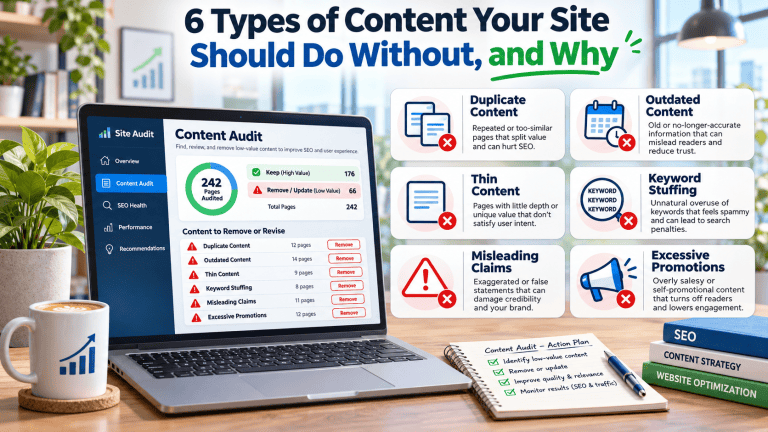
content audit six things to remove 768x432

More content isn't automatically a good thing. A site that publishes constantly but fills its pages with filler, duplication, or stale information is often worse off than one that publishes less but keeps every page genuinely useful — both for the people reading it and for how search engines evaluate it. The six categories below show up across sites of every size, usually added with good intentions, and each one quietly works against the site around it. 1. Thin Content That Doesn't Actually Answer Anything Thin content is a page that exists, technically answers a topic in its title, and says almost nothing once you read it: a few generic sentences, no real detail, nothing a reader couldn't have guessed before clicking. It shows up most often on pages created to fill out a template — a service page for every city a business claims to serve, a product description copied from a manufacturer's spec sheet with nothing added. Why it hurts: search engines don't index everything they crawl, and thin pages are one of the most common reasons they decline to. We cover exactly how that plays out — including the Search Console status that flags it — in why thin, duplicated pages quietly stop getting indexed. Beyond indexing, a reader who lands on a thin page and learns nothing leaves immediately, which is its own cost regardless of how the page ranks. What to do instead: write fewer pages and make each one genuinely answer the question it targets, with specific detail a reader couldn't get from a two-second glance. If a page can't say more than a sentence or two of substance, it usually shouldn't be its own page. 2. Duplicate or Near-Duplicate Content This takes a few common forms: the same paragraph pasted across a dozen location or service pages with only a city name swapped, a page copied wholesale from another site, or several pages on the same site quietly competing to answer the same question. Why it hurts: search engines index one version of duplicated content, not all of them, and when you haven't told them which version matters most, the one they pick...

You may find this interesting too.
On This Page G
Explore 4GOODHOSTING
Copyright © 2026 4GoodHosting. All Rights Reserved.
.CA by CIRA
+1 866 708 4678