



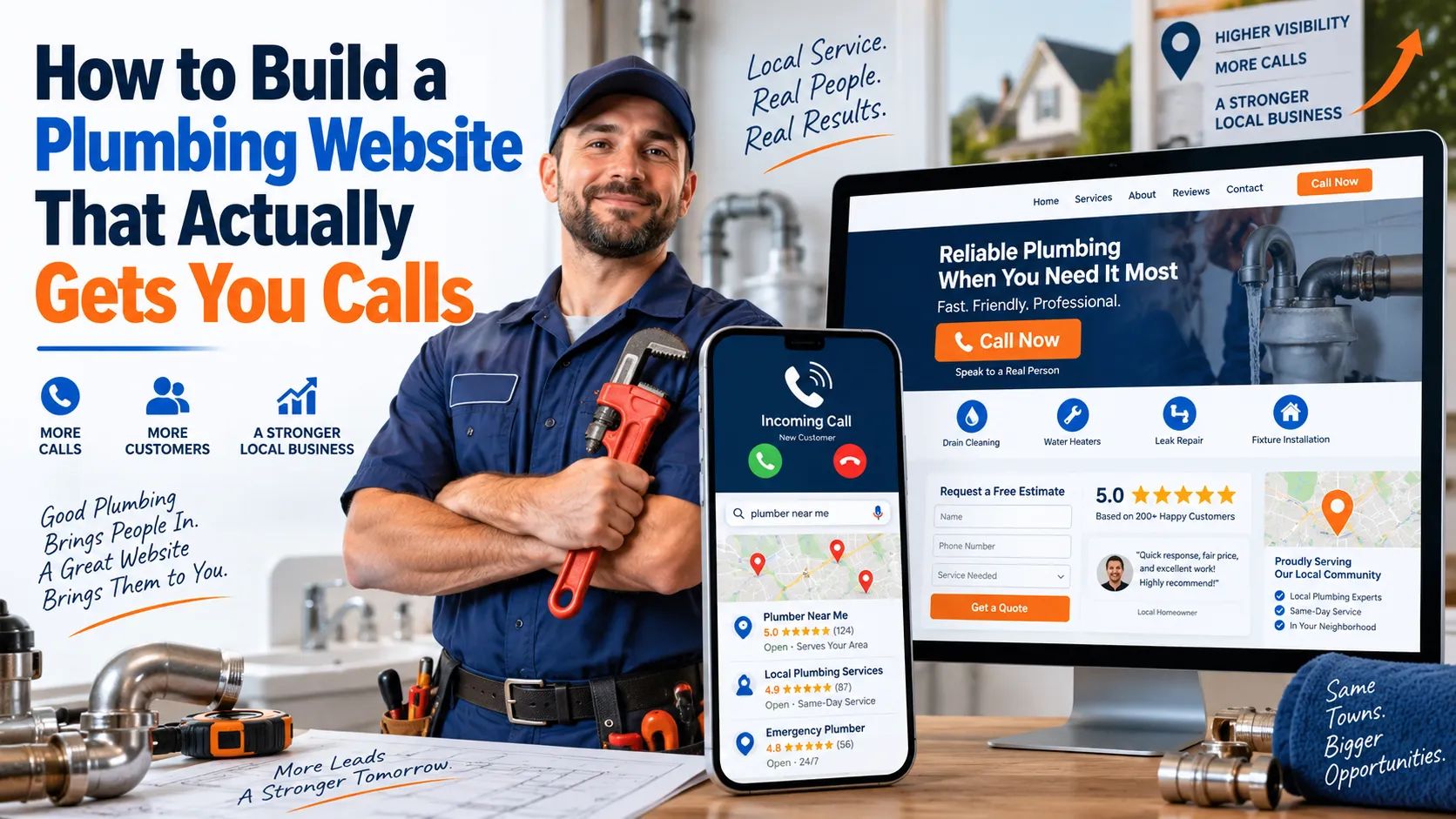
 A plumbing website has one job, and it is narrower than most web design advice assumes. It is not to showcase your brand or to explain your history. It is to make the phone ring when someone with water on their floor searches for help, and to make you the obvious choice when someone with a planned renovation is comparing three companies.
Those are two different visitors with two different urgencies, and a site that serves one badly serves both badly. The emergency caller needs your number and your service area in under five seconds on a phone, possibly at two in the morning, possibly on a weak connection in a basement. The planned-work customer needs evidence you are licensed, insured, competent and reachable, and will read considerably more before deciding.
This guide covers all three parts of getting that right: the design decisions, the local search work, and the hosting underneath it. We are a Canadian web hosting provider, so the hosting section is the part we handle daily, and we have tried to be specific about which hosting factors genuinely matter for a trades business and which are marketing.
It is written for the plumbing business owner who is either building a first website, replacing one that generates nothing, or trying to work out why competitors appear above them in local results. Where something requires a specialist, it says so rather than pretending otherwise.
Start here: your two customers behave completely differently
Almost every mistake in plumbing website design comes from designing for one visitor and forgetting the other. Getting this distinction clear first makes the rest of the decisions obvious.
| Emergency customer | Planned-work customer | |
| Situation | Burst pipe, blocked drain, no hot water, flooding | Bathroom renovation, fixture replacement, new build, inspection |
| Search behaviour | “emergency plumber near me”, “plumber open now”, often on a phone | “bathroom plumbing cost”, “plumber [city] reviews”, often on desktop, over days |
| Time on site | Seconds. They want a phone number | Minutes across several visits. They are comparing |
| What convinces them | You answer, you cover their area, you can come now | Licensing, insurance, reviews, photos of real work, clear pricing approach |
| What loses them | A slow page, a contact form instead of a number, unclear service area | No evidence of credentials, no reviews, no examples, vague about cost |
| What the site must do | Load fast, show a tappable number immediately, state the service area | Build confidence and make comparison easy |
The practical consequence: your homepage has to serve the emergency visitor without burying the planned-work visitor's needs. That usually means a tappable phone number and service area visible without scrolling, and the credibility material immediately below rather than on a separate page nobody reaches.
Web design for plumbers: the pages you actually need
Most plumbing sites have too few pages to rank and too many pages that say nothing. The structure below is the minimum that supports local search without creating filler.
| Page | Purpose | What it must contain |
| Homepage | Capture both visitors; establish the entity | Tappable phone number, service area, primary services, licensing and insurance, reviews, emergency availability |
| One page per service | Rank for service-specific searches | What the job involves, how you approach it, what affects the cost, how long it takes, what the customer should expect |
| Service area pages | Rank for city and neighbourhood searches | Genuinely local content: the areas covered, response times, local specifics. See the warning below |
| About | Trust for the planned-work customer | Real people, real photographs, years in business, credentials, who will actually turn up |
| Reviews or testimonials | Social proof | Real reviews. Link to your Google profile rather than only curating your own |
| Gallery or recent work | Evidence of competence | Your own photographs of your own jobs. Before and after where it makes sense |
| Contact | Convert the deliberate visitor | Phone, form, service area, hours, emergency contact route |
| Pricing approach | Reduce friction and filter poor-fit enquiries | Not necessarily a price list. How you quote, call-out structure, what affects cost |
The service-area page trap
This is where plumbing websites most often break, and it is worth stating bluntly because it is the single most common cause of pages being crawled and then left out of Google's index.
The temptation is to build forty pages by taking one template and swapping the city name. “Plumber in Etobicoke”, “Plumber in Scarborough”, “Plumber in North York”, identical but for the place. It is fast, it feels like SEO, and it produces thin duplicate content that generally does not get indexed. Worse, a section full of near-identical pages can affect how Google assesses the rest of the site.
What works instead: fewer area pages with real substance. Actual response time to that area, neighbourhoods and landmarks you genuinely know, housing stock specifics that affect plumbing work there, jobs you have done there with photographs, and reviews from customers in that area. If you cannot write two hundred words about an area that could not appear on any other page, do not create the page. Cover it in a service area list on your main pages instead.
A workable rule: build area pages only for the places that genuinely generate work, and only where you have something specific to say. Three strong area pages outperform thirty templated ones, and they will not drag the rest of the site down. Our local SEO for Canadian cities guide covers the approach in more depth.
The emergency path: designing for a phone in a basement
This is where plumbing differs most from other small business websites, and where the highest-value traffic is won or lost.
Assume the conditions are hostile. A mid-range phone, a weak signal in a basement or a utility room, one hand holding the phone and the other dealing with water, and no patience whatsoever. Every design decision should be tested against that scenario rather than against a designer's monitor.
- Make the phone number a tappable tel: link, not an image and not plain text. Someone should be able to call in one tap.
- Put it in the header on every page, and repeat it at the bottom of long pages.
- State your service area near the number. The second question after “can I call you” is “do you come here”.
- Say plainly whether you answer after hours, and be honest. “24/7 emergency service” that goes to voicemail at 2am costs you the customer and earns you a review you do not want.
- Keep the emergency path free of obstacles: no interstitial pop-up, no cookie banner covering the number, no chat widget hijacking the screen, no video autoplaying over a weak connection.
- Make the page fast. A page that takes six seconds on mobile data has lost to whoever loaded in two.
On speed specifically, since it is measurable rather than a matter of taste: Google assesses Core Web Vitals on real-user data at the 75th percentile, with Largest Contentful Paint at 2.5 seconds or less, Interaction to Next Paint at 200 milliseconds or less, and Cumulative Layout Shift at 0.1 or less. For a plumbing site the commercial argument is stronger than the ranking one. The emergency visitor does not wait, and layout shift on a phone means a mis-tapped number. We cover the mechanics in Core Web Vitals and hosting.
| The single most common plumbing website failure A contact form where the phone number should be. Forms suit the planned-work customer and are useless to the emergency one, who will not fill in a form while water spreads across a floor. Have both. Phone number first and prominent, form available for people who prefer it or who are enquiring about scheduled work. |
Trust signals specific to the trades
For the planned-work customer, this is the whole decision. They are letting a stranger into their home to do work they cannot evaluate, and every one of your competitors claims to be reliable. Specific, checkable evidence is what separates you.
- State your provincial licence and, where appropriate, the number. Requirements differ by province, so be accurate rather than vague.
- Liability coverage and workers' compensation registration where applicable. Say it plainly.
- Certifications and trade qualifications, including gas fitting or backflow prevention where you hold them, since those answer specific searches.
- Real photographs of real people. Stock images of models in clean overalls actively reduce trust, because customers recognise them.
- Your own work, photographed. Even phone photographs of completed jobs beat stock imagery.
- Reviews with substance, and a link to your Google profile so they can be verified.
- How long you have operated, and whether you are locally owned.
- What happens if something goes wrong: your warranty or guarantee, stated concretely.
One thing to avoid, because it is both ineffective and a compliance risk: unverifiable superlatives. “Best plumber in Toronto” and “number one rated” are claims you cannot substantiate, they carry risk under Canadian rules on misleading representations, and customers discount them automatically. “Licensed, insured, and 400 reviews averaging 4.8 on Google” is stronger precisely because it is checkable. We have written about the trust dimension for Canadian trades in local hosting and customer trust for Canadian trades.
SEO for plumbers: what actually moves the needle
Local search for a trades business is a different discipline from general SEO, and the ordering of effort matters because most of the value sits in two or three places.
Where plumbing customers actually find you
Three surfaces, and they respond to different work. The local map results, which are driven primarily by your Google Business Profile, proximity to the searcher, and your reviews. The organic results below them, driven by your website's content and authority. And increasingly AI-generated answers, which draw on the same underlying information and reward clear, structured, unambiguous facts about your business.
The practical implication is that your Google Business Profile is not a side task to your website. For “emergency plumber near me” it is frequently the primary thing being ranked, and a beautiful website with a neglected profile will lose to the reverse.
Google Business Profile as a service area business
This is the most commonly mishandled part of plumbing SEO, and getting it right is free.
Most plumbers are what Google calls a service area business: you travel to customers rather than having them visit you. Google's requirement is that if you do not have a storefront with signage where customers can come to you, you hide your address and instead define the regions you serve. Listing a home address as a visitable location when it is not one is a guidelines problem and can put the listing at risk.
Beyond that, the items that actually matter:
- Choose the most accurate primary category, then add relevant secondary categories. This has a direct effect on which searches you appear for.
- Define your service areas honestly. Padding them with places you would not realistically travel to weakens the signal rather than widening your reach.
- Set accurate hours, and set emergency or 24-hour availability only if it is true.
- Add real photographs regularly. Profiles with current, genuine images perform better and it costs you nothing but a phone.
- Use the services section to list what you actually do, in the words customers use.
- Answer questions in the Q&A section, including seeding the obvious ones honestly.
- Keep your name, address and phone number identical across your website, your profile and directory listings. Inconsistency is a common and avoidable weakness.
Reviews: the part with the most leverage
For local trades, reviews are close to decisive. They influence map rankings, they are the first thing a comparing customer reads, and they are the hardest thing for a competitor to replicate quickly.
What works is a process rather than good intentions. Ask every satisfied customer, at the moment the work is done and they are pleased, which is when they will actually do it. Make it one tap by sending a direct link. Respond to every review including the negative ones, calmly and factually, because prospective customers read your responses as closely as the reviews. And never buy reviews or incentivise them in ways that breach platform policies; the risk is losing the profile that generates your work.
One technical point that catches people out. If you publish and control reviews on your own website, that self-serving review content is not eligible for star ratings in Google's organic results. Genuine third-party reviews on your Google profile are what appear in local results. So collect reviews where they count, and treat testimonials on your own site as conversion material rather than as an SEO tactic.
Structured data: use the Plumber type, not generic LocalBusiness
Structured data tells search engines and AI systems what your business is in machine-readable terms. Most plumbing sites either omit it or use the generic type when a specific one exists.
Google's own LocalBusiness documentation instructs you to use the most specific subtype available, and it explicitly shows a trades example combining types, in the form of an array such as Electrician, Plumber and Locksmith for a business offering several. So a plumbing business should use the Plumber type rather than plain LocalBusiness, and should add other applicable types where genuinely accurate.
For a service area business, the important property is areaServed, which defines the cities, regions or postal areas you cover. That lets you describe your coverage without asserting a storefront address you do not have. Include your business name, phone number, hours, and links to your profiles.
Realistic expectations, since this is oversold: structured data does not directly move you up the local map results, which are driven by your profile, proximity and reviews. What it does is help search engines and AI systems identify your business confidently and consistently, which supports your overall visibility and how accurately you are described. It also has to stay current, since stale hours or an old phone number in your markup will be repeated by AI assistants that read it.
Two rules to follow: mark up only what is visible on the page, and never mark up ratings you do not genuinely have. Both are policy violations and both are detectable. Validate what you publish with Google's Rich Results Test and check Search Console afterwards.
Content that actually earns plumbing traffic
Most trades blogs are abandoned after four posts because nobody could see the point. The point is narrow: capture the searches that happen before someone is ready to call, and answer the questions your customers already ask you.
What works for plumbing specifically:
- Cost guides. “How much does it cost to replace a water heater” is high-volume, high-intent, and most competitors dodge it. You do not need a fixed price; explain the range and what moves it.
- Emergency first-aid content. How to shut off the water, what to do about a frozen pipe before help arrives. This ranks, it is genuinely useful, and it earns goodwill from someone who will then call you.
- Seasonal content timed to Canadian conditions. Frozen pipe prevention before the first freeze, spring thaw and basement flooding, outdoor tap shut-off in autumn.
- Decision content. Repair or replace, tank versus tankless, when a drain problem needs a camera inspection.
- The questions from your own phone calls. If three customers a month ask the same thing, that is a page.
What does not work: generic industry news, thin posts written to hit a publishing schedule, and anything a homeowner would never search for. A dozen genuinely useful pages beat sixty filler ones, and the filler actively harms how the rest of the site is assessed.
Web hosting for plumbers: what matters and what does not
This is our own field, so we will be specific about which factors genuinely affect a plumbing business and which are sold harder than they deserve.
What genuinely matters
| Factor | Why it matters for a plumbing business |
| Uptime and reliability | Emergency searches happen at all hours. A site down at 2am on a Saturday in February is down during your most valuable window, and you will never know what it cost |
| Server response time | Your emergency visitor is on mobile data with no patience. Server response sets the floor for how fast the page can possibly be |
| Capacity for seasonal spikes | The first hard freeze and the spring thaw produce genuine traffic surges. A plan sized for a quiet Tuesday fails on the day that matters most |
| Automatic backups you can restore | A trades site is usually maintained part-time by a non-specialist. Being able to undo a mistake matters more than it does for a company with an IT team |
| SSL certificate | Any site taking enquiries needs it. Browsers flag sites without it, and a security warning destroys trust instantly |
| Support that answers | When your site is down and you are on a job, you need a person, not a knowledge base article |
What is oversold
- Unlimited anything. An acceptable use policy defines a real limit somewhere.
- Enormous storage and bandwidth. A plumbing site with a photo gallery is small. This is rarely your constraint.
- A VPS or dedicated server for a typical local trades site. Almost never necessary. A well-run shared or managed plan handles this workload comfortably, and managed WordPress hosting is usually the better answer than a VPS hosting if you want performance without administering anything.
- Claims that Canadian hosting improves your Canadian rankings. It reduces latency for Canadian visitors, which helps page speed, and Google determines geographic relevance from your domain, content, Search Console targeting and links rather than your server's location.
For a plumbing business serving one city or region, the honest recommendation is a reliable shared or managed WordPress plan with good uptime, automatic backups, an SSL certificate and support you can reach. Canadian web hosting from Canadian data centres reduces round-trip latency for Canadian visitors, which genuinely helps your mobile page speed. That is the accurate version of the Canadian hosting argument, and it is enough of an argument on its own.
Seasonal capacity, which is the one plumbing-specific hosting issue
Plumbing demand is sharply seasonal in Canada, and search traffic follows it. The first sustained freeze generates a spike in frozen pipe searches. The spring thaw generates basement flooding. A regional cold snap can produce a day of traffic several times your normal volume, concentrated into hours.
That has a specific implication: your site needs to survive a day it sees a handful of times a year, and those are the days with the most revenue attached. Confirm that caching is enabled so most visitors are served without touching your application, and confirm what happens if traffic multiplies. If you run WordPress, speeding up a slow WordPress site covers the practical steps.
Domain, email and the basics people get wrong
Quick but consequential. Your domain should be short, memorable, and sayable over the phone, because plumbing referrals happen verbally. A .ca signals Canadian relevance and requires meeting CIRA's Canadian presence requirements; a .com is fine too, and owning both is cheap insurance.
Avoid stuffing the domain with keywords and hyphens. “best-emergency-plumber-toronto-24-7.com” is hard to say, looks untrustworthy, and confers no ranking benefit worth the cost. Our choosing a domain name for a Canadian small business guide covers the decision, and domain registration is where to register.
On email: use an address at your own domain, not a free webmail account. A quote arriving from a generic free address undercuts every trust signal on your website, and for a business asking to be let into someone's home that matters. One practical caution: do not run your own mail server on your web hosting. A fresh hosting IP has no sending reputation, and the failure mode is quotes landing silently in spam. Use a proper email service.
Build it yourself, use a builder, or hire someone?
This is the first real decision and most guidance on it is written by whoever is selling one of the options. Here is the honest comparison for a plumbing business.
| Route | Suits you if | Genuine drawback |
| Website builder, DIY | You serve one area, competition is moderate, and you have a weekend plus the patience to maintain it | Templates limit the page structure local SEO needs, and you own less of the result. Export options are often poor if you outgrow it |
| WordPress, DIY | You want control and a proper page structure, and you are willing to learn a little | Maintenance is genuinely ongoing: updates, backups, security. Managed hosting removes most of that burden |
| WordPress built by a contractor | You want it done properly once and can maintain content yourself afterwards | Quality varies enormously. Ask to see plumbing or trades sites they built and check whether those sites actually rank |
| Full agency, site plus ongoing SEO | You are in a competitive metro, competing against companies with hundreds of reviews | The expensive option, and the one where you most need to evaluate carefully rather than buy on promises |
Two things worth knowing before you choose. First, the site is the smaller half of the job. In competitive markets, reviews and your Google Business Profile do more for emergency searches than design does, so a modest site with disciplined review collection beats a beautiful site with twelve reviews. Budget accordingly rather than spending everything on the build.
Second, whoever builds it, insist on owning things. Your domain should be registered in your own name, your hosting account should be yours with the builder granted access, and the content should be yours outright on payment. Plumbers regularly discover at the point of a dispute that the person who built the site controls the domain, and recovering it is slow and sometimes unsuccessful.
If you go the WordPress route and do not want to administer a server, managed WordPress hosting handles updates, backups and security at the platform level, which removes the most common reason DIY trades sites fall over eighteen months after launch.
What happens after the phone rings
A website that generates enquiries you then mishandle is an expensive way to disappoint people. This part sits outside web design and it determines whether the design work pays off.
The unglamorous truths about trades lead handling:
- Answer speed decides most jobs. An emergency caller who reaches voicemail calls the next result. If you cannot answer while working, an answering service that takes real details beats voicemail comfortably.
- Form submissions decay fast. A quote request answered the same day converts far better than one answered in three days, and the customer has usually contacted two other companies.
- Decide who answers when you are under a sink. This is a business process question that no amount of web design solves, and it is where most website investment quietly leaks away.
- Log where every enquiry came from. Phone, form, Google profile, referral. A month of this tells you where to spend next.
- Follow up on quotes that go quiet, once, politely. Many are lost to silence rather than to a competitor.
On booking systems: online booking works well for scheduled work such as inspections, fixture installation and quotes, and poorly for emergencies, where people want to speak to someone who can tell them when a van will arrive. If you add booking, add it for planned work and keep the phone number dominant for urgent jobs. A booking widget that displaces your phone number on an emergency page costs more than it earns.
One practical warning if you take any customer details through your site, which a quote form does: you are collecting personal information, and that carries obligations. Keep the form fields to what you actually need, secure the site with SSL certificates, and do not email quotes containing customer addresses to a free webmail account. This is a modest amount of care rather than a compliance project, but it is worth doing deliberately.
Pre-launch checklist
Run through this before you tell anyone the site is live. Most of it takes minutes and each item is something plumbing sites routinely miss.
The essentials
- Phone number is a tappable link, in the header, on every page
- Service area stated near the phone number on the homepage
- Emergency availability described accurately, including what happens after hours
- Licensing, insurance and workers' compensation registration stated
- SSL certificate installed and the site loads over https with no warnings
- Real photographs of your own work and your own people, not stock
- Every service you want to be found for has its own page
- No pop-up, banner or chat widget covering the phone number on mobile
Search and local
- Google Business Profile claimed and set up as a service area business, with the address hidden if you have no visitable storefront
- Primary and secondary categories chosen accurately
- Name, phone and address identical across the site, the profile and any directories
- Plumber schema markup implemented with areaServed, and validated in the Rich Results Test
- Search Console property verified and a sitemap submitted
- Every page has a unique title and a descriptive H1
- Review collection process decided, with a direct review link ready to send
Technical and operational
- Tested on a real mid-range phone on mobile data, not a resized desktop browser
- Core Web Vitals checked, with the main image sized correctly and not lazy-loaded
- Automatic backups enabled, and one restore tested
- Email on your own domain, using a proper mail service rather than the web server
- Domain registered in your own name, with auto-renewal and transfer lock enabled
- Contact form tested end to end, including that the notification actually arrives
- Someone is responsible for answering enquiries, and they know it
Canadian specifics worth getting right
- Provincial licensing differs. State your credentials accurately for your province rather than using generic language, since customers and competitors both notice.
- Workers' compensation registration is province-specific and worth naming, because homeowners increasingly ask.
- Winter is a business driver. Build the seasonal content before the season, not during it, because ranking takes time and the freeze does not wait.
- Service areas should reflect real driving distances in Canadian conditions. Claiming a region you cannot reach in winter generates enquiries you will decline and reviews you will regret.
- If you serve Quebec, French-language content is both a commercial opportunity and a compliance consideration, since Quebec's Charter of the French Language treats commercial publications as within scope regardless of medium. Confirm your own obligations with a qualified adviser.
- Prices in Canadian dollars, stated as such. It sounds obvious and it is regularly ambiguous.
Measure leads, not rankings
A plumbing website succeeds or fails on whether the phone rings. Rankings are an input; calls and booked jobs are the output, and the two can move independently.
What to track: phone calls originating from the site, which requires either call tracking or at minimum asking callers how they found you; form submissions and what proportion become jobs; which pages and which search queries precede an enquiry, from Search Console; your visibility in map results for your core services and areas; and review volume and average rating over time.
The single most useful low-tech measurement is asking every caller where they found you and writing it down for a month. That tells you more about what is working than most analytics configurations, and it costs nothing. If most of your work comes from the map results, your Google profile and reviews deserve the effort. If most comes from organic pages, your content and service pages do.
Be patient in the right way. Local search results respond faster than national organic competition, but a new site still needs weeks to be indexed and months to become competitive. Judge over a quarter, and judge on enquiries.
Twelve common plumbing website mistakes
| Mistake | Why it costs you |
| A contact form instead of a phone number | The emergency customer will not fill in a form. This is the most expensive single error |
| Phone number as an image or plain text | Not tappable on mobile, which is where the urgent traffic is |
| Forty templated city pages | Thin duplicate content that generally does not get indexed, and can affect how the rest of the site is assessed |
| Claiming 24/7 service that goes to voicemail | Loses the customer and earns a review you cannot remove |
| Stock photos of models in clean overalls | Customers recognise them, and it reduces trust rather than building it |
| No licensing or insurance information | The planned-work customer's first question, unanswered |
| Google Business Profile with a visible home address | A guidelines problem for a service area business, and it puts the listing at risk |
| Generic LocalBusiness schema, or none | Google's documentation says to use the most specific subtype, and Plumber exists |
| Marking up your own testimonials for star ratings | Self-serving reviews on your own site are not eligible in organic results |
| Unverifiable superlatives | “Best plumber in the city” is unsubstantiable, carries misleading-representation risk, and customers discount it |
| Cookie banner or pop-up covering the phone number | Actively blocking your highest-value conversion path |
| Ignoring seasonal capacity | The day traffic multiplies is the day with the most revenue attached |
Conclusion
A plumbing website is a lead generation tool with two audiences, and almost every decision follows from that. The emergency visitor needs a tappable number, a stated service area and a page that loads on mobile data in a basement. The planned-work visitor needs licensing, insurance, real photographs, genuine reviews and an honest account of how you price. Serve both on the same page and you have solved most of the design question.
On search, the ordering is unglamorous. Your Google Business Profile set up correctly as a service area business, with accurate categories and defined coverage, does more for emergency searches than anything on your website. Reviews, gathered through an actual process rather than hoped for, are the highest-leverage ongoing work. Service pages with real substance beat templated area pages, and three good area pages beat thirty thin ones. Use the Plumber schema type rather than the generic one.
On hosting, the requirements are modest and specific: reliable uptime because emergencies do not keep business hours, fast server response because your visitor has no patience, headroom for the seasonal days that carry disproportionate revenue, automatic backups because you are maintaining this yourself, and support that answers when you are on a job. You almost certainly do not need a VPS.
If you do one thing after reading this, ask every caller for a month where they found you and write it down. That single habit will tell you whether your next effort belongs in your Google profile, your reviews, your service pages or your site speed, and it will save you from spending money on the wrong one. If you would rather have help interpreting it, SEO services works with Canadian trades businesses on exactly that, and reliable Canadian web hosting with SSL certificates covers the foundation either way.
FAQ
How do I make a plumbing website that actually gets calls?
Design for two visitors. Put a tappable phone number and your service area where the emergency customer sees them without scrolling, and put licensing, insurance, real photographs and genuine reviews immediately below for the customer comparing companies. Then set up your Google Business Profile properly as a service area business, because for “emergency plumber near me” that profile is frequently what is being ranked rather than your website.
What pages does a plumbing website need?
A homepage serving both visitor types, one page per service you want to rank for, a small number of genuinely substantive service area pages, an about page with real people and credentials, reviews, a gallery of your own work, a contact page, and a page explaining how you price. That is enough to compete locally without creating filler.
How much should a plumbing website cost?
It varies too widely to quote a useful figure, and anyone giving you a number without asking about your service area, competition and service range is guessing. The more useful framing is what you are buying: a template site you maintain yourself is inexpensive and adequate for many single-city plumbers, while competing in a large metro against established companies with hundreds of reviews is a bigger investment in content and local SEO than in design.
Do plumbers need a website if they have a Google Business Profile?
The profile does a great deal of the work for emergency searches, so it is the higher priority if you can only do one. But a website is where the planned-work customer verifies you, where you rank for service and cost searches the profile cannot capture, and it is an asset you control rather than one on a platform that can suspend it. Do the profile first, then the site.
How do I set up Google Business Profile for a plumbing business?
As a service area business. If you do not have a storefront with signage that customers visit, Google requires you to hide your address and define the regions you serve instead. Then choose the most accurate primary category, add relevant secondary categories, define service areas honestly, set truthful hours including emergency availability, add real photographs regularly, and keep your name, phone and any address identical across your site and directories.
What schema markup should a plumbing website use?
The Plumber type rather than generic LocalBusiness. Google's own structured data documentation instructs you to use the most specific subtype available and shows a trades example combining types in an array. For a service area business, use the areaServed property to describe the cities or regions you cover instead of asserting a storefront address. Mark up only what appears on the page, and validate with the Rich Results Test.
Should I build a separate page for every city I serve?
No, unless each page has genuine substance. Templated pages that differ only by city name are thin duplicate content, they usually do not get indexed, and a section full of them can affect how Google assesses the rest of your site. Build pages only for areas that genuinely generate work and where you can write something specific: real response times, local housing stock, jobs you have done there with photographs, reviews from that area.
Why do my testimonials not show star ratings in Google?
Because reviews you host and control on your own website are self-serving review content and are not eligible for star ratings in organic results. Genuine third-party reviews on your Google Business Profile are what appear in local results. Collect reviews where they count, and treat testimonials on your own site as material that converts visitors rather than as an SEO tactic.
What hosting does a plumbing business need?
Less than most providers will sell you. Reliable uptime because emergency searches happen at all hours, good server response time because your urgent visitor is on mobile data, enough headroom for seasonal spikes like the first freeze, automatic backups you can restore yourself, an SSL certificate, and support that answers a human. A well-run shared or managed WordPress plan handles a typical local plumbing site comfortably; you almost certainly do not need a VPS.
Does website speed matter for a plumbing business?
More than for most small businesses, and for commercial reasons as much as ranking ones. Your highest-value visitor is on a phone, possibly on a weak connection in a basement, with an urgent problem and no patience. Google assesses Core Web Vitals on real-user data at the 75th percentile, with Largest Contentful Paint at 2.5 seconds or less, but the practical point is simpler: the visitor who waits six seconds calls the company that loaded in two.
Does hosting in Canada help my local rankings?
Not directly. Google infers geographic relevance from your domain, content and language, Search Console targeting and links, not from your server's location. What Canadian hosting does is reduce round-trip latency for Canadian visitors, which improves page speed and therefore the experience for your mobile emergency traffic. That is a real benefit, and it is not a ranking bonus.
How long before a new plumbing website starts generating work?
Local search generally responds faster than national competition, but expect weeks for indexing and months to become genuinely competitive. Your Google Business Profile and reviews can produce enquiries sooner than your website's organic rankings will. Judge over a quarter, and judge on booked jobs rather than positions.
Key takeaways
- A plumbing website serves two completely different visitors: the emergency caller who needs a tappable number in seconds, and the planned-work customer who needs credentials and evidence. Design for both on the same page.
- A contact form where the phone number should be is the most expensive single error on plumbing sites.
- Test the emergency path on a real mid-range phone on mobile data, not a resized desktop browser.
- For “emergency plumber near me”, the Google Business Profile is frequently what is being ranked, not the website. Do the profile first.
- Most plumbers are service area businesses. Google requires the address hidden where there is no storefront customers visit; define service areas instead.
- Use the Plumber schema subtype with areaServed, not generic LocalBusiness. Google's own documentation says to use the most specific type available.
- Structured data does not directly lift you in the local map results, which are driven by the profile, proximity and reviews. It helps identification and consistency.
- Reviews you host on your own site are self-serving and not eligible for star ratings in organic results. Collect them where they count.
- Three substantive service-area pages beat thirty templated ones, and the templated version usually does not get indexed at all.
- Unverifiable superlatives carry misleading-representation risk and customers discount them. “Licensed, insured, 400 reviews averaging 4.8” is stronger because it is checkable.
- Hosting requirements are modest and specific: uptime, server response, seasonal headroom, backups, SSL, reachable support. A typical local plumbing site does not need a VPS.
- Canadian hosting reduces latency for Canadian visitors. It is not a local ranking bonus.
- The highest-value measurement is asking every caller where they found you, for a month, and writing it down.