

4GoodHosting
Live Help
24/7 Support
Blog Menu G
Search
Categories
m
m

Category: VPS Hosting

chatgpt image sep 4 2026 09 36 13 pm 768x432.webp

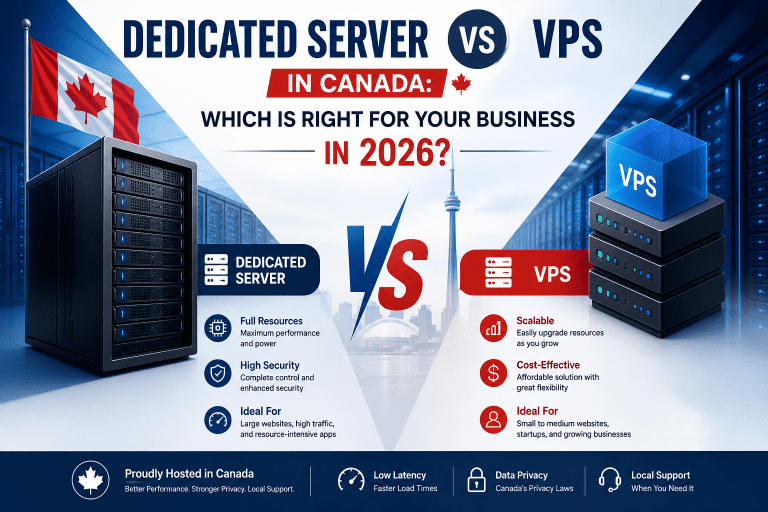
Canadian VPS hosting occupies an awkward middle ground. It costs several times what shared hosting does, it asks more of you technically, and the sales pages describing it are written almost entirely in specifications that mean nothing until you know which of them constrains your site. So this guide is organised around the decision rather than the product. The first question is whether you need a VPS at all, because a large share of businesses who buy one did not need to and a smaller share needed one two years before they bought. The second is managed or unmanaged, which is the choice people most often get wrong and the one with the largest hidden cost. Only then do specifications matter. It also covers what a VPS genuinely fixes and what it cannot touch, since the most common disappointment with a VPS upgrade is a site that is still slow afterwards. That outcome is predictable in advance, and predicting it correctly saves the money. The Canadian dimension is real but narrower than most hosting marketing suggests: latency for Canadian visitors and data residency are genuine considerations, and a Canadian IP address is not a search ranking advantage. Both are covered honestly below. What a VPS actually is A virtual private server is a partition of a physical machine with resources allocated to you specifically. You get a defined amount of CPU, memory and storage, your own operating system instance, and root or administrative access. Other customers share the same hardware, but not your allocation. That last distinction is the whole product. On shared hosting, your site's performance depends partly on what other accounts on the machine are doing, because CPU and memory are pooled. On a VPS, your allocation is yours whether the neighbours are busy or idle. You are buying predictability rather than raw speed. Type Resource model What you manage Typical fit Shared Pooled across many accounts Nothing below the control panel Brochure sites, low-traffic blogs, early-stage businesses VPS Allocated to you, on shared hardware Depends on managed or unmanaged Growing sites, ecommerce, uneven traffic, custom software needs Dedicated An entire physical machine Full stack, or the provider's...

You may find this interesting too.
chatgpt 27 768x432.webp

Most hosting comparisons answer the wrong question. They line up two products, declare that one is cheap and one is powerful, and leave you to guess which description fits your site. The guessing is where the money gets wasted — either on a plan too small to hold your traffic, or on a server that costs five times more than you need and requires skills nobody on your team has. The useful question isn't which product is better. It's this: what is your site actually asking for right now, and what will it ask for in eighteen months? Answer that, and the choice between shared and VPS hosting stops being a judgment call and becomes an obvious one. This guide covers both sides honestly. It explains what shared hosting has genuinely become in the last few years, which is not what most articles still describe. It sets out the benefits of VPS hosting without pretending it's a free upgrade. It gives you the specific, measurable signals that tell you when you've outgrown a shared plan — not vague advice about "growing sites." And because your visitors, your customers, and in many cases your legal obligations are Canadian, it covers the part almost nobody writes about: where your data physically sits, and why that increasingly matters. Shared vs VPS hosting at a glance Before the detail, the short version. Shared hosting places many customer accounts on one physical server, each with a capped allocation of CPU, memory, processes, and disk I/O, all managed by the provider. You get a control panel and a website; you never touch the operating system. VPS hosting (Virtual Private Server) uses a hypervisor to divide one physical server into several independent virtual machines. Each one runs its own operating system, holds its own reserved slice of CPU and RAM, and can be configured down to the kernel by whoever holds root access. Shared hosting VPS web hosting Resource model Capped share of a pooled server Reserved allocation, guaranteed to you Operating system One OS shared by all accounts Your own OS instance Root access No Yes (on unmanaged and most managed plans) Who patches the server...

You may find this interesting too.
chatgpt 28 768x432.webp

Search for VPS hosting in Canada and you'll get a page of results that look nearly identical. Canadian flags, promises of low latency, a mention of strong privacy laws, a pricing table, a call to action. Read the fine print on those same pages and something else emerges. One is published by a company headquartered in California, billing in US dollars, with a currency disclaimer noting that exchange rates and bank fees will change what you actually pay. Another announced a Toronto location and then quietly froze it, a fact discoverable only in the blog comments where a staff member suggested New York or Chicago as alternatives. A third is a template with the country name swapped out — the same article exists on the same site as "VPS Hosting in Australia" and "VPS Hosting in India." None of that makes those companies bad hosts. It does mean "Canadian VPS hosting" is a claim rather than a specification, and the difference between the claim and the reality is where Canadian businesses get caught: a support queue that answers at 3 a.m. Eastern, an invoice that moves with the dollar, a data-residency question in a client questionnaire that suddenly has an awkward answer. This guide is about buying well. It assumes you've already worked out that you need a VPS rather than a shared plan. If you're still deciding that, our comparison of shared vs VPS hosting walks through the resource ceilings and upgrade triggers in detail. From here on, the question is narrower and more practical: among providers all claiming to offer Canadian VPS hosting, how do you tell which one actually does, and which one fits your business? VPS hosting, defined precisely A Virtual Private Server is one physical machine divided by a hypervisor into several independent virtual machines. Each one runs its own operating system, holds a reserved allocation of CPU cores, RAM, and disk, and is administered by whoever holds root access. Your instance is isolated from the other tenants on that hardware at the virtualisation layer. That's the whole concept. The reserved allocation is what distinguishes it from shared hosting, and the shared physical hardware is...

You may find this interesting too.
chatgpt image may 5 2026 07 46 13 pm 768x512

Businesses tend to be a bit scrappy when they’re young, and that hyper competitiveness comes from the fact securing new customers and building a base of them is of make-or-break importance in the early days. Before the introduction of the Internet a new business had to put their focuses elsewhere, but since the start of the World Wide Web a new business is going to live or die in large part based on how well it does with making itself visible and appealing online. Owners insist on having a website that is fully available to potential customers at all times, and that is what leads a lot of them to dedicated server hosting in Canada. If you have a site needing sufficient breathing room then a dedicated server is going to be the best choice. That’s because there is no other type of web hosting package available that will make the entirety of a server’s resources available to you site, and you site only. Your only option to give your website all that breathing room and with the whole spread of resources available exclusively at all time is to have a dedicated server, and while it is going to the most expensive type of web hosting if you have a business that will be operating in the eCommerce space then it’s likely this will be money well spend a thousand times over. You certainly won’t want to be losing would-be customers on account of slow-loading homepage or any other slowdown when they’re on your site, and all of that is framed around the age-old reality that says you never get a 2nd chance to make a 1st impression. This becomes a much more real possibility if you site is up via a shared hosting arrangement and your site is sharing the server with others. If you foresee your site having traffic spikes and new site visitor numbers growing exponentially then you will almost certainly do well to go with VPS hosting or dedicated server hosting right off the hop. Again, it’s going to be money well spent and this is even more true if you have reason to foresee your...

You may find this interesting too.
chatgpt image apr 21 2026 07 50 45 pm 768x615

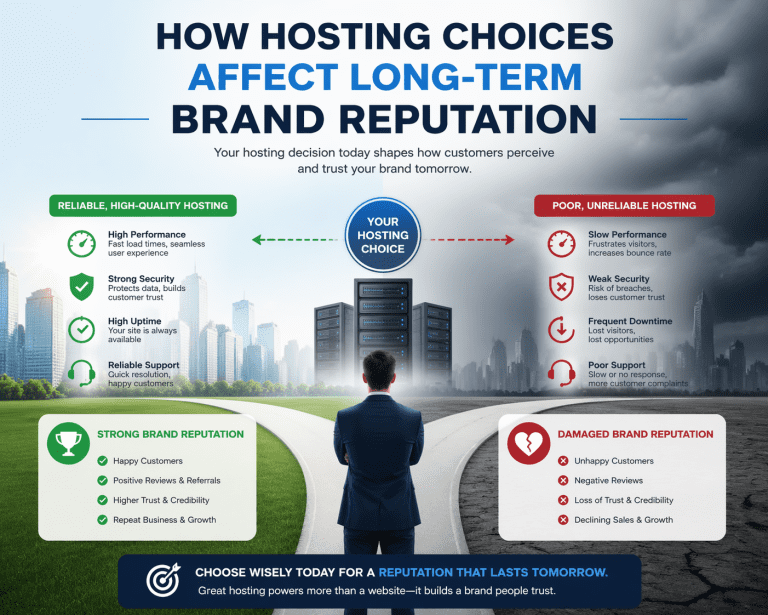
The long-standing way of thinking as to whether or not something is reliable, or someone is reliable is different. If something is reliable then the tool, implement, or device is going to work, while that someone is a person you can count on that person to be available and capable when you need them. Any business website will need to have secure hosting for brand reputation, but web hosting isn’t a tool, an implement or a device either. It’s really more of a resource for businesses and personal interest ventures. And an invaluable one for businesses because without it your website is nowhere to be found. There is also a lot that goes into building a brand for businesses, and the way any of them make themselves visible and identifiable online is a core part of having a legit brand. You can say quite fairly that your web hosting is not as much of a part of your brands as your logo or other visuals, for example, but it is something of a part of it in a much more indirect way. And it ties back into the idea of being reliable, but in this case it has more to do with how prospective customers expect that you’ll have yourself and your products/services/whatever readily available for them to look over and compare online. They expect you to be reliable in this way. Every site that allows for transactions via the site is going to need to have the right protocols in place, and that starts with SSL certificates. You may also need to be considering data privacy compliances as per PIPEDA, and GDPR regulations. Of course your brand would suffer if there were any repeated incidents of sensitive data being taken after your site is the result of a cyber security attack, and one thing we like to tell new customers with a business site in mind is that one of the many advantages of VPS hosting is that there’s a higher tier of website security that comes with that type of webs hosting. What we’ll do with this week’s entry is look at how your hosting choices and factor...

You may find this interesting too.
chatgpt 36 768x512.webp

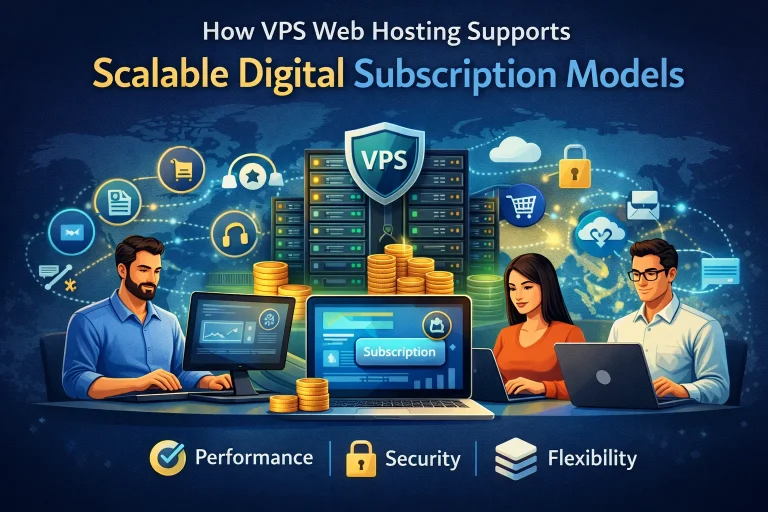
You’ll have an everyone and anyone and anybody else mindset towards convincing people to sign up when you have a subscription website. Where the aim is to get people to subscribe to whatever it is you’re offering. Looking at it from a business development perspective it’s fair to say that one of the benefits of drumming up business this way is you have to have your product / service/ whatever it-is packaged up and made deliverable in the best possible way. You’re not going to keep those subscriptions very long if you stray from that, and another part of this is looking at the need for scalable hosting for subscription websites. The type of web hosting you choose to go with if you have one of these websites serving your business interests can have a factor in the extent to which you’re able to scale your site. It’s going to be a good thing if your site needs to get new pants because it’s grown a lot, and in this instance that is going to mean a lot of signing up via the website. A lot of people use subscription services through a website, and I myself have a product subscription for regular replacement of the blades for my electric razor. That’s just one example of an online business that may be getting WordPress hosting for subscription sites. Really what you want to have happen here if you’ve just started to offer an online subscription service is to have it catch fire online, and that can certainly happen if you’re product or service is made visible in the right places online and you’ve got something that is genuinely of good quality and / or unique within a nice in the marketplace. Your website and it’s ability to handle eCommerce transactions is going to be of central importance to all of this and that often means that shared hosting might not be the best fit. VPS web hosting is typically much better for scaling a website and providing the available resources for a scaled and larger website to breathe at full volume. This may have site masters considering subscription website hosting...

You may find this interesting too.
chatgpt 31 768x512.webp

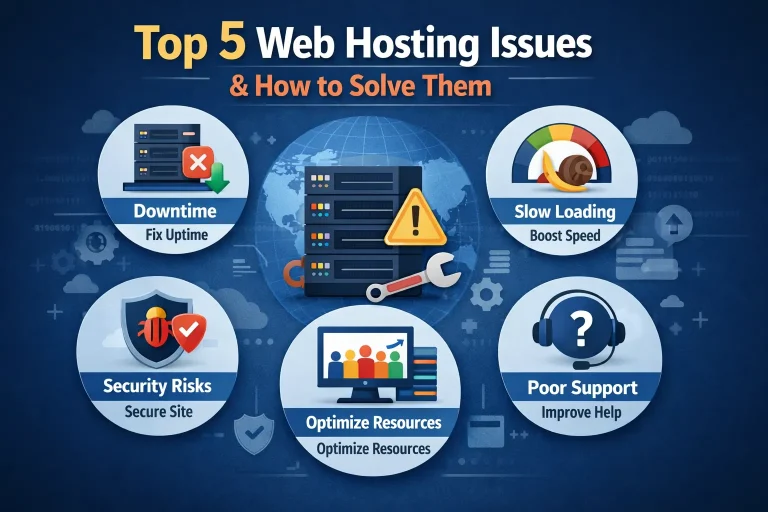
To remain competitive, "simply going online" will not be enough in 2026. To successfully navigate the current landscape of digital commerce, you will need to build a sophisticated, resilient, fast, and globally compliant digital infrastructure. The strain on traditional hosting models due to the increasing number of resource-intensive technologies, such as AI-powered customer service agents, real-time analytics, and 8K video streaming, has never been greater. At 4goodhosting, we understand that effective transformation of your business digitally begins with developing a deep understanding of the underlying technical challenges. By grasping the fundamental concepts of data transfer physics, the logic of server resources, and the unique intricacies of cyber security that drive these issues, you can create a reliable, high-performing online business. Whether you are an ambitious entrepreneur attempting to launch and scale your first e-commerce website, CTO(Chief Technology Officer) at a large and growing global media company, you surely are dealing with the same challenges currently found in the industry today. Below is a list of the top five web hosting issues defining the industry in 2026, along with the professional solutions from 4GoodHosting to help you successfully overcome them. Performance Bottlenecks and the "Latency Tax" By 2026, the importance of speed will no longer be seen as a luxury and is now considered an integral part of delivering value to customers. For example, search engine algorithms have incorporated load time into their formula for decision-making on document ranking, therefore search engines rate pages based on load times. Furthermore, consumers now have almost no patience for delay. In addition to the increased importance of speed, many growing businesses are experiencing performance challenges due to the increase in size and complexity of today's web assets; businesses are now experiencing "performance walls." Businesses that had fast and responsive websites last year are now experiencing delays while trying to load their website due to the increased size and complexity of their modern web assets. Problem Performing slow, poorly performing web applications typically result from using instances where a website is hosted in an overcrowded shared environment that is not optimized for performance. Simply put, if you are using a shared environment, you will experience...

You may find this interesting too.
firefly gemini 6 768x560.webp

An online presence can be created in a manner similar to opening a business in the Greater Toronto Area (GTA)—for example, business starts out quite small, is generally inexpensive initially, and over time, one learns how to navigate various challenges. Currently, many (if not all) entrepreneurs and creators in Toronto use shared hosting initially, as it is quite inexpensive and easy to set up; it will successfully support web traffic at the beginning phase of his/her project. However, as traffic starts to increase beyond what was anticipated, or the need for more sophisticated applications becomes apparent, or the entrepreneur discovers how critical data security is (not just "a nice thing to have"), the need for a more suitable environment for the project arises. In other words, it's like trying to operate a fully equipped commercial kitchen out of your apartment studio. At some point, it will become necessary to make a move away from shared hosting, so the most logical option would be to move to Toronto VPS. Although not quite as affordable as shared hosting, it is much less expensive compared to having your own dedicated server, and yet it gives the website an appropriate professional platform to carry out your ever-increasing demands. The Growing Pains of Shared Hosting Imagine shared hosting as an apartment building. You have your own unit (your website) but share all utilities (server resources such as CPU, RAM, and bandwidth) with your neighbors. This works fine for small websites with low traffic. Costs are split; everyone has enough to get through. But as your website gains in popularity and experiences traffic spikes, or as more resource-intensive applications are being run, these would become bottlenecks. Suddenly, your website is very slow in loading, experiences downtime, or shuts down. This not only annoys you; it can severely affect your business, resulting in lost clientele, diminished sales, and a tainted reputation. Here are some of the common indicators that you are outgrowing shared hosting: Slow Performing Website: It takes ages to load pages, images take forever to upload, and visitors bounce off your site. Frequent Bridges out: Your site is inexplicably offline for periods, leading to missed...

You may find this interesting too.
pngtree a row of hosting servers with blue lighting in a black picture image 11968151 768x431.webp

The city of Toronto is quickly establishing itself as one of North America's leading environments for startup companies and Software as a Service (SaaS) providers, offering vast resources in world-class technology talent, an active category of investors and its proximity to major markets in the United States and Canada. For a technology-oriented business, there are endless possibilities. Although many companies take this factor for granted, one common area that can greatly help or hinder a company in its quest for growth is hosting. Web hosting goes far beyond the technical, as it significantly impacts performance, compliance, security, user experience, and future scalability. This article outlines everything you need to consider regarding startup web hosting Toronto; SaaS hosting Toronto; PIPEDA compliant hosting Canada; What you should know about VPS hosting Canada and supporting new businesses at all levels of development with companies such as 4GoodHosting. Why Web Hosting Is a Strategic Decision for Startups and SaaS Companies In a startup's early days, speed, flexibility, and reliability are nearly everything. Your website or SaaS application is typically very first touchpoint of users with the brand. If slow to load, crashing unexpectedly, or simply feeling unreliable, users might never give a second chance to your product. Unforgiving, indeed, are first impressions on the digital realm. Adding more to the stakes is the fact that for SaaS companies, their products become their platforms. Any degraded performance, any downtime, security vulnerabilities-somehow all these affect trust, renewals, and revenue. Unlike traditional businesses, the stability of infrastructure for SaaS companies is not negotiable- users expect constant access to their accounts. An ideal hosting solution would help startups and SaaS companies: Deliver artefacts to the user at a fast load time and consistent application performance Provide high availability and minimal downtime Secure sensitive customer and business data Comply with Canadian data privacy regulations and standards Smoothly scale resources with increasing traffic and user demand These factors go a long way in determining user retention, conversions, and long-term brand trust. So now, more and more Toronto-based founders are reconsidering their infrastructure setup and opting for local, scalable hosting solutions instead of generic international providers that might not satisfy Canadian...

You may find this interesting too.
chatgpt 7 768x768.webp

The most obvious question about technology, as a matter of course, is, "Will AI take web developers' jobs?" [This is also why many people search for Will AI Replace Web Developers (And How Should You Adapt)?] A pretty substantiated question, but we can witness huge software codes generating itself and builders doing intelligent development more than ever before or, into the future, futuristic-looking tools, great boring jobs-ChatGPT, GitHub Copilot, Claude, Cursor, and all those AI site builders. But fact remains AI is changing web development, but not in a time when web developers will suddenly find themselves replaced by the new kid on the block. Certainly not in the nearer future, and definitely not for those willing to change. This is the Age of AI, and lucky enough, it has been closely following the pattern of the technology revolution, in which vehicles took over horses. Initially, there was a whole lot of panic amidst the scribbles of newspaper editorialists, but instead of actually "destroying" transportation, the automobile has been rather successful in redefining it, by creating a plethora of new jobs, new industries, and more. AI does to web development nowadays. Now, this post will discuss AI benefits and downsides and how developers (and agencies) can go with the social change by updating their strategies, mindsets, and tools. This shift also increases demand for best web hosting Canada for AI-powered websites. Section 1: How AI Is Transforming Web Development Direct-and- obvious, though. AI has proved itself: it has phenomenal capacity in performing some tasks. Automation of repetitive tasks: Work that would have taken several hours shrinks to a few minutes. Some of the areas of work involved in automated tasks include: Writing boilerplate codes Creating CSS layouts Generating components Bug fixing Running tests Writing documentation I even created a content scheduling tool for making the calendar, and normally I would spend six hours to eight hours on it, but two hours later, with AI-based development, I had my first working version-all productivity boost, no real replacement skill. Faster than human code writing. Modern tools can in a few seconds create full-fledged live applications in HTML, CSS, Javascript, or WordPress plugins....

You may find this interesting too.
On This Page G
Explore 4GOODHOSTING
Copyright © 2026 4GoodHosting. All Rights Reserved.
.CA by CIRA
+1 866 708 4678