

Blog Menu G
Search
Categories
m
m

Day: November 9, 2026

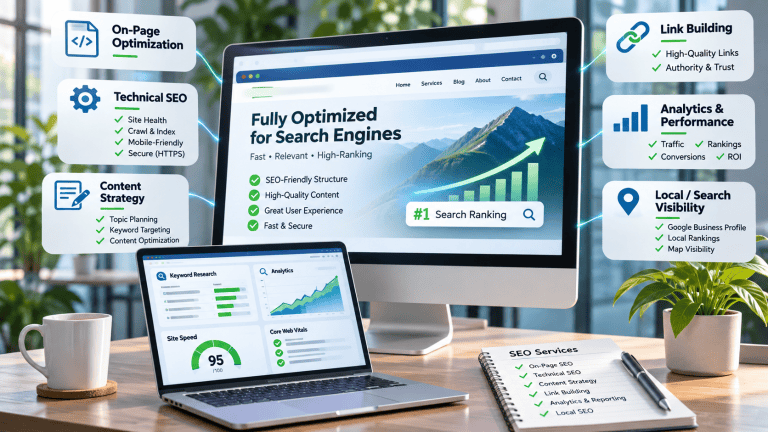
modern seo workspace dashboard 768x432
reading time Reading Time: 9 minutes

Wanting something is not the same as needing it, but these days whether you want it or need it you are more likely than not going to be proceeding to find it online via a Google search on your smartphone or notebook. Or via Safari, Bing or Firefox - whichever web browser is to your liking. Every time that happens the searcher will be presented with a list of websites that match their search criteria, but the ones that come up on the first page of that list of matches is of pivotal importance for the provider who’s got their website serving their business interests. Search engine optimization of the site is a big deal if you’re operating an eCommerce venture of any sort, and site masters will be looking affordable SEO services for small businesses. Fortunately they’re not hard to find, and most good Canadian web hosting providers will provide an eCommerce SEO service that can be obtained alongside their hosting package. This sort of overview and revision of a site’s search engine optimization is especially valuable when one of these eCommerce businesses is just getting of the ground and the business is being taken online for the first time. That’s self explanatory, as being increasingly more visible to customers conducting searches is going to mean more orders being placed and the business starting to grow at a time when there’s going to be some fragility to the operation. You do need to start making some money with whatever it is you’re doing, and with local SEO services you can have your site even better tailored to be coming up higher in SERPS (search engine results pages) for people who are making searches locally. Meaning that they’re people who live in the region and who would be most pleased to find a local provider. Which ideally will be you. However, if you’re not coming up at least relatively high in search engine results there’s significantly less of a chance that happens. It’s unrealistic to think you’ll be at the top of page 1 immediately, but you need to start at least making the effort to get your site ranking...
You may find this interesting too.
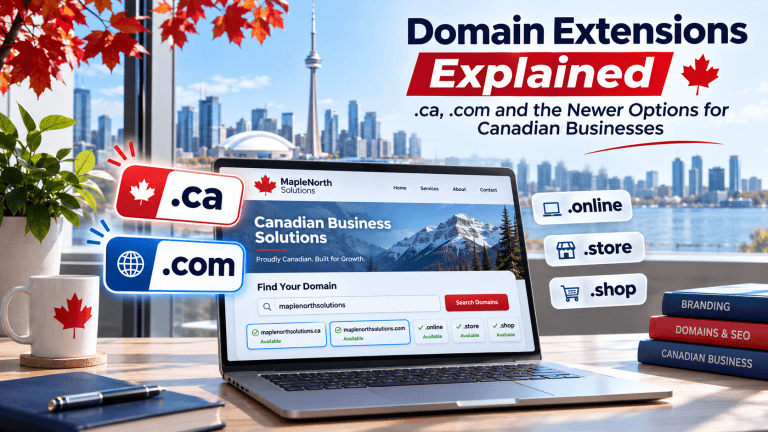
canadian domain extensions explained 768x432

Choosing a domain name used to mean choosing between .com and, for Canadian businesses, .ca. Today there are hundreds of other endings available, from .shop and .tech to .online, .app and .law. Some are useful. Some are mostly marketing. A few carry risks that aren't obvious when you register them. The part of a domain after the final dot is called its extension, or top-level domain. It affects how customers read your address, how search engines interpret it, how email filters treat it, what it costs to renew, and in some cases how your website must be configured. It's worth understanding before you register one. A domain extension, or top-level domain (TLD), is the last part of a domain name, such as .ca, .com or .shop. There are three main kinds: country-code extensions like .ca, generic extensions like .com and .org, and newer generic extensions introduced since 2012 like .shop and .tech. For most Canadian businesses, .ca and .com remain the safest main choices, with newer extensions best used for specific campaigns or products. This guide explains the types of domain extensions, how the newer ones came about, how customers, search engines and email systems treat them, the costs and technical requirements to watch for, and when a newer extension makes sense for a Canadian business. The Main Types of Domain Extensions Every domain extension is managed by a registry, which sets the rules for who can register names and at what wholesale price. Registrars then sell those names to the public. The extensions fall into a few broad groups. Type Examples Who can register Notes Country-code (ccTLD) .ca, .uk, .de, .fr Usually limited to people or organizations connected to the country, depending on the registry Signals a national connection; .ca is managed by CIRA under Canadian presence rules Original generic (gTLD) .com, .net, .org Anyone .com is the default most people type; .org is common for non-profits but open to all Sponsored or restricted .gov, .edu, .int Restricted to specific types of organization Not available to ordinary businesses Newer generic (new gTLD) .shop, .tech, .online, .app, .law, .design Usually anyone; some have eligibility rules Introduced through ICANN's new gTLD...

You may find this interesting too.
On This Page G
Explore 4GOODHOSTING
Copyright © 2026 4GoodHosting. All Rights Reserved.
.CA by CIRA
+1 866 708 4678