

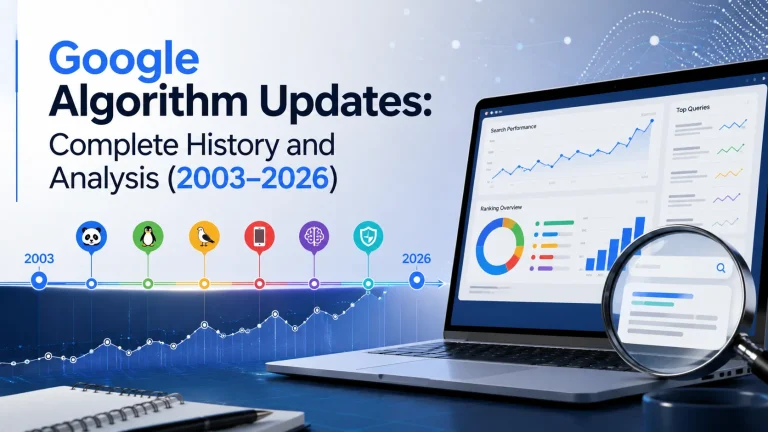


There is no shortage of Google algorithm update timelines. What is genuinely scarce is a timeline that gets the classifications right. Most published lists put "Medic," "Fred," "Phantom," and the March 2024 core update in the same column, as though they were the same kind of event. They aren't. Two of those are nicknames the SEO industry invented for ranking volatility it noticed but Google never named. One is a documented, dated, officially announced rollout with a published start and end. Treating them as equivalent is how teams end up rewriting content to recover from an "update" that was actually a manual policy enforcement action, or waiting out a "core update" that was really an indexing infrastructure change. This guide separates them. It covers the named Google algorithm updates from Boston in February 2003 through the August 2026 spam update, sorted into seven classes, with rollout durations for the modern confirmed era. It also does something the standard timeline doesn't: it analyses the rollout data itself, because how long an update takes to deploy is a diagnostic signal most SEOs never use. What counts as a Google algorithm update — and what doesn't Before any timeline is useful, you need a taxonomy. Google runs thousands of changes to Search every year and announces only a small fraction of them. The things that get announced fall into distinct categories that call for completely different responses. A ranking system is a persistent component of how Google ranks — RankBrain, BERT, PageRank, the spam-detection system, the reviews system. Systems run continuously. An update is a change to one or more of those systems, deployed over a defined window with a start and completion date. A core update is a broad revision to Google's overall ranking systems, affecting relevance and quality assessment across all types of queries. Core updates are not penalties. Nothing is "wrong" with a page that drops during one; Google has simply revised how it weighs usefulness. A spam update improves the systems that detect and neutralise manipulative practices — scaled content abuse, link schemes, expired domain abuse, cloaking. Unlike core updates, spam updates do imply something is wrong, and the...