


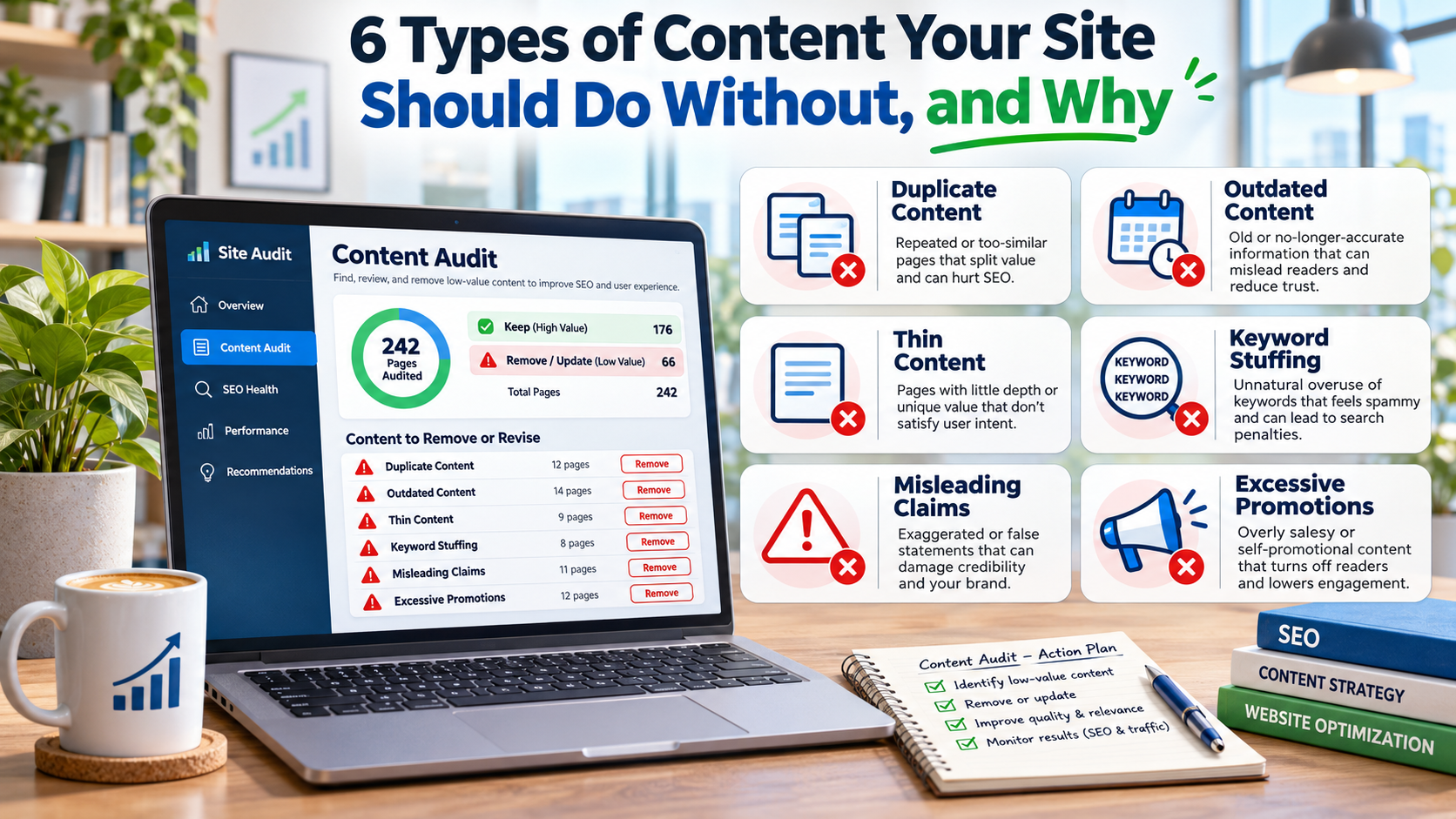
 More content isn't automatically a good thing. A site that publishes constantly but fills its pages with filler, duplication, or stale information is often worse off than one that publishes less but keeps every page genuinely useful — both for the people reading it and for how search engines evaluate it. The six categories below show up across sites of every size, usually added with good intentions, and each one quietly works against the site around it.
1. Thin Content That Doesn't Actually Answer Anything
Thin content is a page that exists, technically answers a topic in its title, and says almost nothing once you read it: a few generic sentences, no real detail, nothing a reader couldn't have guessed before clicking. It shows up most often on pages created to fill out a template — a service page for every city a business claims to serve, a product description copied from a manufacturer's spec sheet with nothing added.
Why it hurts: search engines don't index everything they crawl, and thin pages are one of the most common reasons they decline to. We cover exactly how that plays out — including the Search Console status that flags it — in why thin, duplicated pages quietly stop getting indexed. Beyond indexing, a reader who lands on a thin page and learns nothing leaves immediately, which is its own cost regardless of how the page ranks.
What to do instead: write fewer pages and make each one genuinely answer the question it targets, with specific detail a reader couldn't get from a two-second glance. If a page can't say more than a sentence or two of substance, it usually shouldn't be its own page.
2. Duplicate or Near-Duplicate Content
This takes a few common forms: the same paragraph pasted across a dozen location or service pages with only a city name swapped, a page copied wholesale from another site, or several pages on the same site quietly competing to answer the same question.
Why it hurts: search engines index one version of duplicated content, not all of them, and when you haven't told them which version matters most, the one they pick isn't always the one you wanted found. Near-duplicate pages also compete with each other rather than building authority on one strong page. This is covered in more depth, including how canonical tags and consolidation fix it, in our website indexing guide.
What to do instead: write unique, locally or specifically relevant detail for each page that needs to exist, or merge overlapping pages into one stronger one rather than leaving several thin, competing versions live.
3. Outdated Content Nobody Has Revisited
A "2022 pricing guide" still live and ranking in 2026, a seasonal offer page for a promotion that ended two years ago, a statistics roundup citing figures that have since been superseded, a copyright year in the footer that never got updated — stale content accumulates on every site that doesn't have a review cycle for its older pages.
Why it hurts: a visitor who notices outdated information on one page reasonably wonders what else on the site is stale, which undermines trust in pages that are perfectly current. Search engines also weigh freshness for topics where it matters — pricing, regulations, and anything time-sensitive — so an unmaintained page can lose ground to a competitor's more recently updated one even if the underlying advice hasn't really changed.
What to do instead: put a standing review date on content that can go stale — pricing, statistics, anything with a year in it — and either update, redirect, or remove it on a schedule rather than leaving it live indefinitely by default.
4. Intrusive Pop-Ups and Interstitials
A full-screen email signup, discount offer, or cookie banner that covers the entire page the instant someone arrives, before they've read a word, is one of the most common ways a site drives away a first-time visitor.
Why it hurts: Google treats an intrusive pop-up as a usability problem, not just an annoyance, and factors page experience into how it evaluates a site. Set that aside and the more immediate cost is simpler: a visitor who hits a wall before seeing any actual content has every reason to just leave, and most do.
What to do instead: if a pop-up genuinely earns its place, delay it until someone has actually engaged with the page — scrolled partway, spent a reasonable amount of time, or reached the end of an article — and make it easy to dismiss with one click.
5. Content Built Purely to Bait Backlinks
This is content whose only real purpose is to attract links — an "ultimate list" stuffed with exact-match anchor text pointing at paid or traded links, a guest post accepted purely because it came with a link requirement, or a page assembled around a statistic nobody checked because it was designed to get cited, not to be accurate.
Why it hurts: search engines' spam policies specifically target unnatural link patterns, and a page built around link acquisition rather than genuine usefulness tends to read exactly that way to both readers and algorithms. Our off-page SEO guide and the importance of link building for SEO both cover what a healthy, durable backlink profile actually looks like, and it isn't this.
What to do instead: earn links by publishing something genuinely worth citing — original research, a uniquely clear explanation, a resource nothing else on the topic quite matches — and let links follow from that rather than engineering them directly.
6. Unedited AI-Generated Filler
Content generated wholesale and published with no fact-checking, no editorial judgment, and no verification that its claims are actually correct has become its own recognizable category — generic phrasing, plausible-sounding but unverified specifics, and a flatness that comes from nobody having actually thought about what the reader needs.
Why it hurts: search engines' guidance on content quality is about whether content is genuinely helpful and created with people in mind, not about which tool produced the first draft — but unedited, unchecked output tends to fail that bar for the same reasons thin content does, and it carries the added risk of stating something confidently wrong. A factual error published under your brand's name is a trust problem regardless of where the paragraph originated.
What to do instead: whatever tool or process drafts the content, have a person who actually understands the subject check every factual claim, add anything genuinely specific the draft is missing, and be willing to say "this isn't good enough to publish" rather than shipping a first draft because it was fast to produce.
The Common Thread
Every one of these six categories shares the same root cause: content published because it was easy to produce, rather than because it was worth a reader's time. None of them are fixed by writing more; they're fixed by removing, consolidating, or genuinely improving what's already there, and by setting a standard for what gets published going forward. Good content on a site that's otherwise slow, unreliable, or poorly configured still underperforms, which is where web hosting in Canada and the rest of a site's technical foundation come back into the picture — a fast, stable, well-configured host gives genuinely good content the best chance of actually reaching the people it was written for, in the same way the practices above give it the best chance of being worth that reach in the first place.
FAQ
Does thin content get a whole website penalized, or just the thin pages?
Search engines generally evaluate at the page level first, but a site with a large share of thin or low-value pages can see its overall quality assessment affected, which is one reason consolidating weak pages rather than leaving them live tends to help more than it costs.
Is AI-generated content automatically bad for SEO?
No — the tool used to draft content isn't itself the issue. What matters is whether the published result is accurate, genuinely useful, and checked by someone who understands the subject. Unedited, unverified output tends to fail that standard, not because of how it was produced but because nobody checked it.
How do I find duplicate or near-duplicate content on my own site?
Search a distinctive sentence from a page in quotes to see if it appears elsewhere on your own site or another one, and compare templated pages (location or product pages built from the same structure) for how much is actually unique between them versus copied.
Should old blog posts be deleted or updated?
It depends on whether the underlying topic is still accurate and useful. Genuinely outdated information (old pricing, expired offers, superseded statistics) should be updated or removed; a post whose core advice still holds usually just needs a refresh of any dated specifics, not a full rewrite.
Are pop-ups always a problem?
Not inherently — the issue is a pop-up that blocks the page before a visitor has engaged with it at all. A dismissible prompt that appears after someone has scrolled or spent time on the page is a different, much lower-risk pattern.
KEY TAKEAWAYS
- Thin, duplicate, outdated, intrusive, link-bait, and unedited AI-generated content are six recurring categories worth auditing for on any site.
- Each one tends to get added for the same reason: it was easy to produce, not because it served the reader.
- Thin and duplicate content are common, specific reasons pages fail to get indexed at all.
- Stale, unreviewed content undermines trust even on pages that are otherwise fine.
- An intrusive pop-up on arrival is both a page-experience problem and a simple, direct way to lose a first-time visitor.
- Content built to bait backlinks tends to read as exactly that, to readers and to search engines' spam policies alike.
- AI-assisted drafting isn't the problem; publishing it unchecked and unverified is.
- The fix for all six is usually removal, consolidation, or genuine improvement — not simply publishing more.
CONCLUSION
A content audit that removes or fixes these six categories usually does more for a site than a stretch of new publishing would. Thin pages, duplication, stale information, intrusive pop-ups, link-bait, and unchecked AI filler all share the same fix: a standard for what's worth keeping live, applied consistently rather than as a one-time cleanup. Fewer, genuinely useful pages, on a site that's otherwise fast and reliable, consistently outperform a larger site padded with content that was easy to produce but never worth a reader's time.
READY TO START?
Put your idea online with Canadian web hosting
Hosting from Canadian data centres, cPanel included, and a real team you can call.
See | or call 1-866-708-4678