


 The bulk of a website’s functionality is determined by the server where the site is hosted. Site architecture does factor into it too, but nearly to the same extent. And as far as site usability is concerned it has everything to do with the server being able to handle requests. Which is what happens every time a visitor to your site clicks through to homepage and from there to one of the secondary pages or to a specific site component. Not all servers are the same, and neither are web hosting packages. The primary difference between them is whether that servers is shared between other sites, or whether it’s private and for one site only. Managed WordPress hosting with NVMe is another consideration if it’s a WordPress site for a small business.
That’s because with managed WordPress hosting the provider takes care of every aspect of ongoing site optimization. A website is never a set-it-and-forget-it proposition, and site architecture and other approaches like scalability plus SEO audits and the like are requirements if your site is serving business interests. It’s important that you have the visibility and new customers streams that make up the reason you have a website in the first place. Managed hosting tends to be best when a site owner is looking at high-performance WordPress hosting, and that goes doubly if the decision-maker for that business is a very busy individual with a lot on their plate.
Which usually tends to be the case, and a lot of them may not have much web savvy to begin with. Many will never have even heard of PIPEDA compliant hosting and why it’s something that’s often needed for eCommerce websites. The flip side of that is going be the way developers are going to look at all of this, and for those folks who are equipped with sufficient web wherewithal then we are happy to explain why NVMe powered servers are usually the best choice when they can be incorporated into a website and web hosting arrangement.
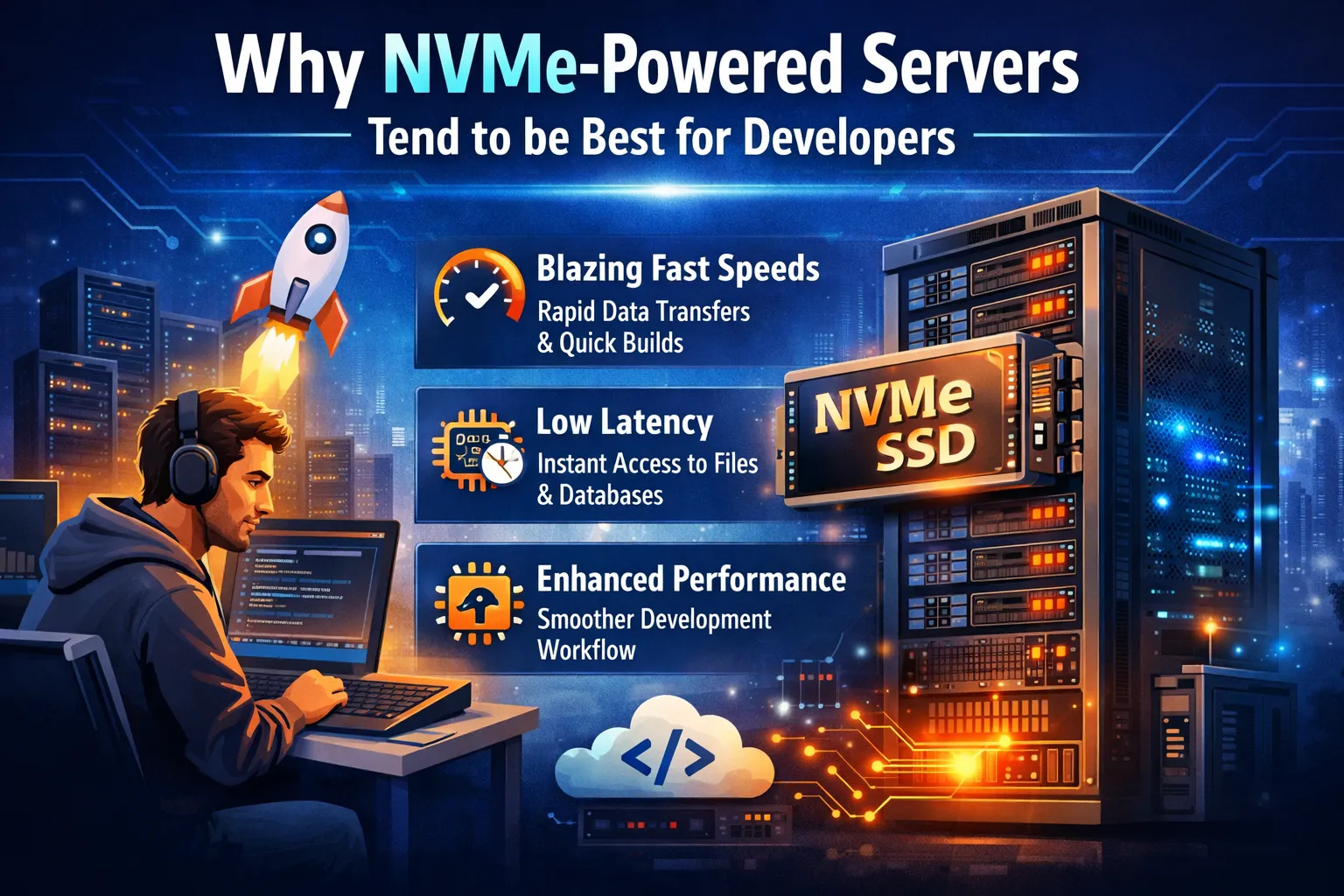
So that’s what we’ll look at with this blog entry, and having these types of web servers be preferable is really reinforced by the fact that flash storage and SSD drives are increasingly prevalent. NVMe drives are usually better because they are scalable, effective, and offer both raw speed and higher capacity for multitasking. Servers using NVMe can respond to user requests almost instantly, no matter what the concurrent operation volume is at any time.
Superior Volume Handler
It’s now more of a challenge for modern businesses to manage mission-critical applications, high-traffic websites, and data-heavy platforms. Any degree of a delay in accessing data can reduce speed, customer satisfaction, and productivity, and they just can’t be tolerated if you have a WordPress site for business. Traditional storage solutions, such as HDD storage and SATA SSDs, often struggle with modern demands. For this reason developers and businesses require solutions that offer exceptional server performance, and managed WordPress hosting with NVMe is right in line with that.
Servers are significantly faster and more stable with NVMe SSDs in dedicated hosting, and the real value in this is when they are processing a large number of users or data simultaneously. If you are in business you want to have your website experiencing traffic spikes, but you want to also be assured that your site’s server is able to accommodate them. NVMe SSDs combine the power of dedicated hosting infrastructure with the advanced architecture of Non-Volatile Memory Express storage. This makes them a super solution for improved server performance and handling those types of volumes.
Let’s start by looking at the technology itself. NVMe stands for Non-Volatile Memory Express and it is a storage technology that by this point has very much changed how servers store and access data. Traditional server storage architectures involved various steps to reach the processor, but this indirectness meant that system performance was lowered. NVMe functions differently, and uses PCIe (Peripheral Component Interconnect Express) technology to minimize latency issues. Because NVMe reads data on a parallel model and communicates directly with the CPU, developers experience faster data transfer speeds.
The way NVMe works with server storage is different too, and also contributes to High-performance WordPress hosting if the web hosting provider is feature NVMe-equipped web servers. Traditional HDD storage read data sequentially or write data one piece at a time, relying on spinning platters and mechanical arms. The process is slow and causes delays or latency issues as operations happened in order. The rollout of SATA SSDs meant an improvement and removed mechanical bottlenecks, but certain limitations remained.
That’s because they used flash memory instead of moving parts, which increased speed. Yet, they remained constrained by SATA interface bandwidth, an older technology that was only a working fit when data needs were much smaller. Speed increases were nice, but this technology struggled to handle today’s massive data requirements. NVMe SSDs changed storage by using PCIe. This is a much faster connection type suitable for modern, high-speed peripherals.
When the NVMe drive is able to communicate directly with the CPU it eliminates the need to pass through slower channels or multiple queues processing thousands of simultaneous commands.
NVMe Technology for Improved Operations
So what we have available now with NVMe dedicated server is a hosting configuration that modern businesses use for faster and more effective server performance. NVMe storage is paired with standard SATA or SAS hard drives, which read and writes data simultaneously for much quicker data access. Allowing websites, apps, and databases to deliver information with minimal delay results in improved latency and responsiveness is going to sound very good to any developer who’s putting together a website or rebuilding an existing one.
The small millisecond delays that came with older and more traditional storage options all added up, but with NVMe dedicated server hosting there’s never any of this happening. The next big plus for any developer with server and hosting options is the way that NVMe SSDs consume less energy. They use less power and produce less heat, so there’s less need for extra cooling systems. Data centers that have more NVMe-equipped servers can have more of them in the same space, and there’s both logistical and energy-efficiency gains to be had because of that.
Providers that have the best price on Managed WordPress hosting with NVMe will usually have data centers that have this type of makeup. The next consideration for developers will be the impact on applications, and they can maximize benefits with NVMe dedicated servers in a big way. These servers eliminate storage-related bottlenecks and result in faster load times, even for high-traffic websites. With NVMe SSDs, the time spent fetching website files and database information is minimized extensively as the drive performs both tasks simultaneously. Developers are going to immediately make the connection between that and increasing user engagement. Which of course is exactly what you want when you have a website that is representing a business and looking to retain site visitors and eventually turn them into paying customers.
Scientists and analysts running big data operations or machine learning workloads also find it beneficial. NVMe servers are also superior for processing of massive datasets that need constant access. Traditional storage often failed to meet these needs. NVMe SSDs are designed to handle these operations in minutes.
Consider these other key benefits:
- PCIe Gen-4 NVMe offers read speeds of 7,000 MB/s and write speeds over 5,000 MB/s. By comparison, SATA SSDs provide a maximum of 600 MB/s
- NVMe drives respond in under 20 microseconds, while SATA SSDs usually take 50–150 microseconds
- Modern NVMe drives can handle millions of write cycles, allowing server infrastructure to manage heavy workloads consistently over many years
Plus no moving parts means with an NVMe-powered server will never present the chance of the mechanical failures that can occur with HDDs. This makes them more durable with a longer operational lifespan. NVMe drives also use advanced technologies like error correction and wear-levelling algorithms to maintain data accuracy and extend flash memory longevity.
Scalability / Resources / Security
Growth is what you want to see for your business, and the developer you’re working with won’t need to be told that you’ll hope to have to scale your website eventually for that reason. Growing businesses want to be able to scale without infrastructure limitations, and sites built for an set on NVMe dedicated servers are going to make that process a whole lot better. That’s because they support scalability requirements by eliminating storage as a bottleneck.
Businesses can add more users, increase transaction volumes, and expand application features without slowing down operations, thanks to fast NVMe storage and high-performance WordPress hosting. This is somewhat dependent on the site being a VPS or dedicated server, as with either of these options it is a scenario where all resources—such as CPU, RAM, storage, and bandwidth—are fully available. This will not be the case with shared hosting environments where multiple virtual servers and websites compete for the same resources, resulting in limited access.
Website security is better with an NVMe dedicated servers too. They offer stronger security than shared hosting or VPS hosting. There is significantly less of a risk of website breaches because of the physical isolation and complete server control, and businesses also have full control over the server environment. Custom configurations and security measures like firewalls, intrusion detection systems, and other protections can be set up as needed. DDoS protection is enhanced as well, and overall site security is always better when you go with managed WordPress hosting with NVMe.
Spec Considerations
The CPU and RAM you choose to go with will have a big impact on server performance, and developers are going to want to make certain they don’t shortchange their NVMe-powered server with an inferior CPU or insufficient RAM. Modern processors come with different numbers of cores and speeds, so it’s important to check if they can meet your workload requirements. NVMe dedicated servers work best when a high-performance CPU configuration is paired with enough RAM.
Developers will do well to have a fairly firm idea of site performance requirements when evaluating their spec needs here. Looking to expected user volume, transaction rate, and data processing demand. High-traffic websites will typically demand more in the way of CPU power, enough RAM capacity, and fast storage. Faster load times increase user engagement and conversions. So they will always be working with understanding that website performance expectations directly influence server specification requirements.
Another important point to understand is that sites that run database-heavy applications will almost always need that higher RAM capacity and fast storage, and having it should be a really priority and something that’s planned for even before the build gets started. This is even more of a need considering the way modern databases often use memory caching to store frequently accessed data in RAM for ultra-fast access.
Choose a CPU based on how many users will be accessing the server at the same time and operational complexity, and then work around the guideline that most modern applications require at least 64GB of RAM. 64GB can be a baseline specification. It’s also advisable to have the correct RAID arrays in place as the site development gets underway. RAID 0 splits data across drives. RAID 1 copies data on two drives, and RAID 10 combines both speed and safety by striping and mirroring data. In short, businesses should select an option keeping both speed and reliability in mind.
Network infrastructure will also be a consideration. With NVMe SSDs it must support fast storage and a network connection that is too slow is going to be a problem and can lead to bottlenecks. So it’s usually best to spend more and get an NVMe SSD that can sustain multi-gigabit throughput. If this can be paired with a hosting provider who features optimal geographic distribution it can reduce delays and provide a fast experience for users everywhere.
RAID 10 disk mirroring is standard with all SSD Linux VPS packages here at 4GoodHosting, and this is likely the direction you want to go in if you don’t have a WordPress site. And be in touch with us if for more information about why PIPEDA compliant hosting is a requirement for certain websites that gather sensitive customer data as part of eCommerce operations.