


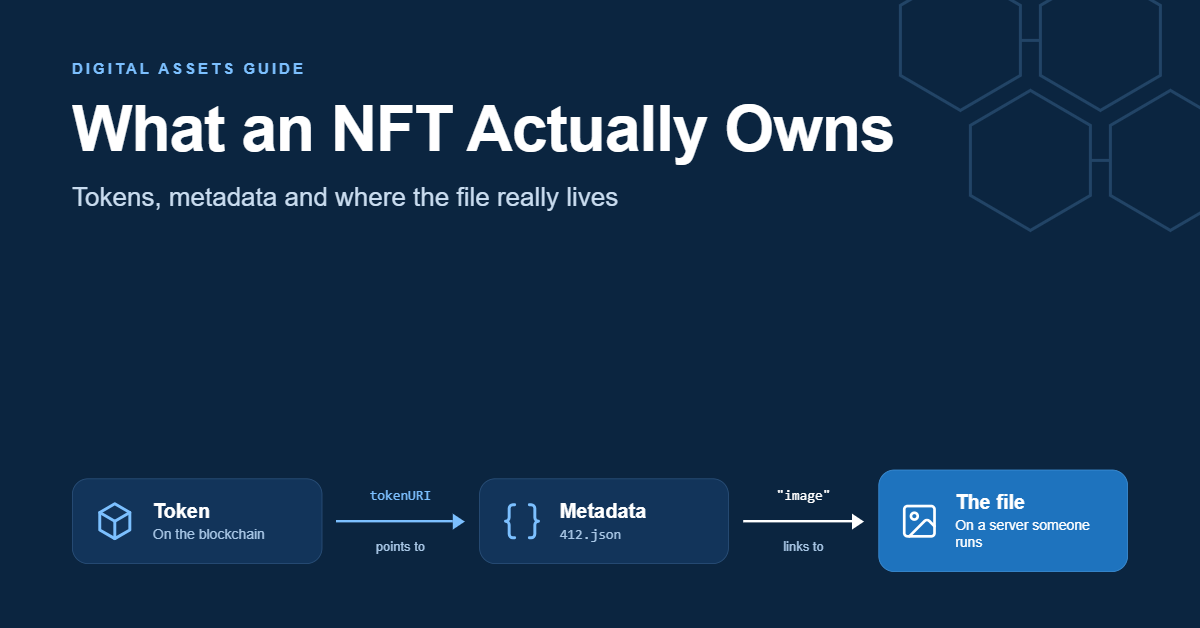
Most people who have bought an NFT believe they own a picture, a song or a ticket. In most cases, what they own is a line in a public ledger that says a particular token belongs to their wallet. That token usually holds a web address. The address leads to a small text file, and the text file leads to the picture. The picture itself sits on a server somewhere, and somebody has to keep that server running.
That chain of pointers is the part of the NFT story that rarely gets explained, and it's where NFTs meet ordinary web hosting. When the server goes offline, the domain expires or the files are never backed up, the token survives but points to nothing.
An NFT (non-fungible token) is a unique token recorded on a blockchain that proves which wallet holds a specific entry in a smart contract. The token normally stores a link to a metadata file describing the item, and that file links to the media. The image, video or document is usually stored somewhere else, not inside the token.
This guide explains what an NFT is, what it actually records, and where NFT files are stored in practice. It covers how NFTs end up pointing to nothing, what buying one does and doesn't give you, and how to check one before you buy or issue it. It finishes with the business uses that outlasted the hype, and what it takes to host NFT media and metadata properly.
What Is an NFT?
An NFT is a token created by a smart contract, a small program running on a blockchain. The contract keeps a list of token IDs and the wallet address that holds each one. When an NFT is sold or transferred, the contract updates that list, and every node on the network records the change.
"Non-fungible" means each token is distinct. One Canadian dollar is interchangeable with any other, which makes it fungible. A concert seat is not: row F, seat 12 is a different thing from row F, seat 13. An NFT works like the seat. Each token ID is unique within its contract, so the pairing of contract address and token ID identifies exactly one item.
Most NFTs follow a shared technical standard so that wallets and marketplaces can read them. On Ethereum, the two common standards are ERC-721, which defines one-of-a-kind tokens, and ERC-1155, which lets one contract manage both unique items and batches of identical ones, such as 500 tickets to the same event. Other blockchains have their own equivalents, but the structure is broadly similar.
What the token itself records
Stripped down, an NFT on a typical standard records four things:
- The contract address, which identifies the collection or issuer.
- The token ID, which identifies the specific item within that contract.
- The current owner, recorded as a wallet address.
- A pointer to metadata, usually a URI returned by a function the standard defines (ERC-721 calls it tokenURI).
That last item is what most explanations skip. It's also where the file actually comes into the picture.
Following one NFT's chain of pointers
A worked example makes the structure concrete. Imagine a ticket NFT from a fictional event series. Looking up token 412 in a blockchain explorer shows the contract address, the current owner's wallet, and a metadata link returned by the contract:
https://tickets.example.com/meta/412.json
Opening that address returns a short JSON file:
{
"name": "Lakeside Night Series – Admission #412",
"description": "General admission, Saturday evening.",
"image": "ipfs://bafy...example-cid/412.png",
"attributes": [
{ "trait_type": "Night", "value": "Saturday" },
{ "trait_type": "Section", "value": "General" }
]
}
So this one ticket depends on three different things staying healthy. The token depends on the blockchain. The metadata depends on the example.com domain, its web server and its TLS certificate. The image depends on someone pinning that IPFS content, and on wallets being able to reach it through a gateway. If the event company lets the domain lapse after the season, the ticket still exists on-chain, but wallets can no longer read its name, its details or its picture.
None of this is unusual. It's the normal architecture of most NFTs, and it's why "where is the file?" is the first question worth asking about any of them.
The Three Layers of an NFT
It helps to think of an NFT as three separate layers, each stored in a different place and each with its own way of failing.
| Layer | What it is | Where it usually lives | Who keeps it available |
| Token | Ownership record: contract, token ID, owner, metadata pointer | On the blockchain | The blockchain network |
| Metadata | A small JSON file with the item's name, description, attributes and a link to the media | A web server, a content-addressed storage network or, less often, on-chain | Whoever hosts or pins the file |
| Media | The image, video, audio, 3D model or document | A web server, a content-addressed storage network or, rarely, on-chain | Whoever hosts or pins the file |
The token layer is the only one with the durability people associate with blockchains. The metadata and media layers are as durable as the storage behind them. If a project hosts its JSON files and images on an ordinary server, those files are exactly as reliable as that server, its domain and its backups.
Why the media isn't usually on-chain
Storing data on a public blockchain is expensive, because every node keeps a copy and every byte written costs a transaction fee. A small text file can be affordable. A high-resolution image or a video generally isn't. So most projects store a short pointer on-chain and put the large files somewhere cheaper.
Some projects do store everything on-chain. This is most common with small generative artwork drawn as SVG code, where the entire image is a few kilobytes of text. Those NFTs don't depend on any outside server, which is a genuine advantage, but the approach only suits small files.
Where Are NFTs Stored?
There are three common places NFT metadata and media live. Each makes a different trade-off between permanence, cost and control.
| Storage approach | How the link works | Can the file be changed? | What keeps it online | Main risk |
| On-chain | Data is written into the blockchain | Only if the contract allows it | The blockchain network | Cost and size limits |
| Content-addressed storage (such as IPFS) | Link is derived from a hash of the file's contents | No. A changed file gets a different address | At least one node choosing to store ("pin") it | Nobody pins it, so it disappears |
| Ordinary web server (HTTP or HTTPS URL) | Link points to a domain and path | Yes, by whoever controls the server | The hosting account, domain and certificate | Server shutdown, domain lapse, silent edits |
Content-addressed storage and pinning
The InterPlanetary File System (IPFS) is the most widely used content-addressed network for NFTs. Instead of pointing to a location ("this file on this server"), an IPFS link points to the content itself through a content identifier, or CID, calculated from the file's data. If even one pixel changes, the CID changes. That gives buyers a strong integrity guarantee: an ipfs:// link in the metadata can only ever resolve to the exact file that was minted.
What it doesn't guarantee is availability. A file on IPFS stays retrievable only as long as at least one node stores it. Nodes keep content they've chosen to "pin", and drop other content over time. If the issuer stops paying a pinning service and nobody else pins the files, the CID still exists but nothing answers when you ask for it.
There's a second subtlety. Many projects don't store ipfs:// links in their metadata. They store a regular web address for a specific public gateway, a web server that fetches IPFS content on the visitor's behalf. That reintroduces a single point of failure, because if that gateway shuts down or changes its policy, the link breaks even though the content may still exist on the network.
Ordinary web servers
Many NFTs, especially from brands, events and early projects, point to files on an ordinary web server, the same kind of hosting used for any website. This is the simplest option to set up, and it has real advantages. It's fast, cheap and familiar, and the issuer can fix errors.
That last point cuts both ways. Whoever controls the server can change the metadata or swap the image behind the URL at any time, and the token on the blockchain won't change. Some contracts also include an administrator function that lets the issuer repoint every token to a new base URL. Buyers who care about permanence should know whether that's possible.
When changing metadata is legitimate
Not every metadata change is a red flag. Many collections launch with a placeholder image for every token and then "reveal" the real artwork days later by pointing the contract at a new set of files. Event tickets may need updated details if a venue changes. Certificates may need corrections. In each case, a server the issuer controls makes the change easy.
What matters is whether the change is disclosed and whether it ever stops. Well-run projects publish when metadata can change and why, and then "freeze" it once the collection is final. They do that either by switching to content-addressed links or by permanently disabling the contract function that changes the base address. Some contracts also emit a standard event when metadata is updated, so that marketplaces refresh their copies. A project that can change every token's image at any time, with no stated policy, is asking buyers to trust it indefinitely.
What Breaks: How an NFT Ends Up Pointing to Nothing
Because the token and the files are stored separately, an NFT can lose its picture without anything happening on the blockchain. The failure modes are mostly ordinary hosting problems:
- The hosting account closes. The project ends, the bills stop and the server is decommissioned. Every metadata link returns an error.
- The domain expires. If the domain in the metadata URL lapses, the links stop resolving. Worse, someone else can register the expired domain and serve whatever they like at the same addresses.
- The TLS certificate expires. Wallets and marketplaces fetch metadata over HTTPS. An expired or misconfigured certificate can make the files unreachable even though the server is running.
- The gateway disappears. Metadata hard-coded to one public IPFS gateway breaks if that gateway closes or starts rate-limiting.
- Nobody pins the content. IPFS content that no node keeps is effectively gone.
- The files are edited. On an ordinary server, the metadata or image can be replaced. That might be a legitimate fix or a bait-and-switch. The blockchain can't tell the difference.
- Server settings block access. Wallets and marketplaces load metadata from their own domains. A server that blocks cross-origin requests, serves JSON with the wrong content type or blocks hotlinking can make the files invisible in the apps people use, even though they open fine in a browser.
- Formats age. A 3D model or interactive file that depends on a particular viewer may stop rendering as software moves on.
None of these is exotic. They're the routine problems of keeping any website online for years, applied to files that buyers expect to last indefinitely.
What an NFT Doesn't Give You
The ownership record is real, but it's narrower than many buyers assume.
It usually isn't copyright. Buying an NFT of an artwork gives you the token, not the copyright in the artwork, unless the sale terms say otherwise. Under Canada's Copyright Act, an assignment of copyright isn't valid unless it's in writing and signed by the owner of the right (or their agent). Many projects grant buyers a licence to display the image, and some grant limited commercial rights, but those terms come from the project's licence, not from the token.
It isn't exclusive possession of the image. Anyone can usually view, download or screenshot the media. The NFT records who holds the token, not who can see the file.
It isn't the physical item. An NFT linked to a physical product, such as a sneaker, a bottle of wine or a piece of art, only matters if the issuer honours that link. That's a contractual promise, not a property of the token.
It isn't a guarantee of value or continuity. If the issuer disappears, the token stays in your wallet, but any perks, access or redemption rights depend on someone still providing them.
How to Check an NFT Before You Buy or Issue One
Whether you're buying a single item or launching a collection for a business, the same checks apply.
- Find the metadata link. Look up the token in a blockchain explorer and read the URI the contract returns for it. Note whether it's on-chain, an ipfs:// link, a gateway URL or a regular domain.
- Open the metadata file. It should be readable JSON with a name, description and a link to the media. Check where that media link points too, because the two can be stored differently.
- Check whether the links can change. Content-addressed links can't. Regular URLs can. Check whether the contract has an administrator function that can change the base URI, and whether the project has frozen it.
- Check who keeps the files online. For IPFS, ask who pins the content and whether it's pinned in more than one place. For a web server, look at the domain's registration and expiry date and check that HTTPS works without warnings.
- Read the licence. Find out exactly what rights come with the token: display, personal use, commercial use or none. If none are stated, assume you have only the token.
- Check what's promised off-chain. If the NFT unlocks a ticket, a membership, a discount or a physical item, find out who delivers it, for how long and on what terms.
- For issuers: plan the storage for years, not months. Decide before minting who will host and pin the files, how they'll be backed up, and what happens to them if the project or the company ends.
Business Uses That Outlast the Hype
The speculative market for digital collectibles was the loudest part of the NFT story, but it was never the only one. A few uses are still worth considering for businesses, because they use the token as a verifiable record rather than an investment.
- Event tickets. A token can represent admission and can be checked at the door, with transfer rules written into the contract. The ticket artwork and event details still live in metadata that has to stay online at least until the event.
- Memberships and loyalty. Holding a token can unlock access to content, discounts or events. The value depends entirely on the business continuing to honour it.
- Certificates and credentials. Course completions, professional micro-credentials and warranties can be issued as tokens that anyone can verify. The certificate's detail, such as the holder's name and course outline, needs careful handling, as the privacy section below explains.
- Provenance records. Artists, galleries and makers of high-value goods use tokens to record a chain of custody that's hard to forge.
Do you need a blockchain at all?
Before building any of these, it's worth asking whether a token adds anything. A ticket scanned against the organizer's own database, a certificate verified on the issuer's website, or a digitally signed PDF solves most of the same problems with less complexity and fewer privacy complications. Open standards such as the W3C Verifiable Credentials model can provide tamper-evident credentials without putting anything on a public blockchain.
A token earns its place when several parties who don't trust each other need to verify ownership or transfers independently, and nobody wants a single company to control the record. If one organization issues, tracks and honours everything, a conventional website and database is usually the simpler and more private choice.
Either way, the result depends on hosting. A token-based ticket still needs a working event page. A verifiable credential still needs a website where it can be checked. The blockchain only replaces the ledger, not the rest of the web presence.
Hosting NFT Media and Metadata Properly
For an issuer, the metadata and media are the part of an NFT project most likely to fail, and the part entirely within their control. Treating them like production infrastructure rather than an afterthought prevents most of the problems above.
Good practice for hosting NFT files includes:
- Use content-addressed links in the metadata where permanence matters, and pin the files with more than one provider, including one you control.
- Mirror the files on your own web server as well, so that you have an independent copy and a fast way to serve them.
- Serve everything over HTTPS, using an SSL/TLS certificate set to renew automatically.
- Serve metadata with the right headers. That means JSON content types, cross-origin headers that let wallets and marketplaces read the files, and caching appropriate to whether the files can change.
- Name files so they never need to change. Treat each published file as permanent. If something must be corrected, publish a new version and document the change rather than silently overwriting it.
- Back up the metadata and media separately from the server that hosts them, and test restores.
- Monitor availability. A simple uptime check on a sample of metadata and media URLs catches failures before buyers do.
- Plan for the end. Decide in advance who will keep the files online if the project winds down, and for how long. Write it into the project's terms.
Choosing the hosting layer
The right setup depends on the size of the collection, the media type and how much control the issuer needs.
| Setup | Suits | Trade-offs |
| Shared web hosting | A minting or project website plus a small, static set of metadata and images | Lowest cost and least administration, but limited control over server headers and resources |
| Virtual private server (VPS) | Larger collections, custom headers, your own mirror and monitoring, or running your own pinning node | Dedicated resources and root access, but someone must handle updates, security and backups |
| Dedicated server | Large video or 3D collections, heavy traffic around launches | Full hardware isolation and predictable performance, at higher cost and with more administration |
For most small issuers, a shared hosting plan is enough for the project website and a mirror of a modest collection. Moving to VPS hosting makes sense when you want full control over headers and caching, or want to run your own storage node so that your files never depend solely on a third party. Running a peer-to-peer storage node uses bandwidth and needs open network ports, so check your hosting provider's terms before setting one up. A dedicated machine is usually only justified for media-heavy collections or high-traffic launches.
Performance on launch day
NFT projects have an unusual traffic pattern. Most of the load arrives at once: when a mint opens, a collection is revealed or tickets go on sale. At that moment, the project website, the minting page and the metadata server all take a burst of requests from buyers, wallets and marketplaces trying to index thousands of new tokens.
A metadata server that slows down or returns errors during that window causes visible problems. Tokens appear in wallets without names or images, and marketplaces may cache the blank result. The usual safeguards are the same ones that protect any busy launch: serve static JSON and media files rather than generating them on each request, put long cache lifetimes on files that will never change, test the server under realistic load beforehand, and keep the minting site on infrastructure sized for the peak rather than the average day. Hosting close to the audience also helps. For a Canadian event or brand, servers in Canada cut the round-trip time for most buyers.
Domain and certificate hygiene
A surprising number of broken NFTs trace back to a lapsed domain rather than a failed server. If your metadata uses your own domain, treat it as long-term infrastructure:
- Register it for several years and turn on auto-renewal with a payment method that won't expire unnoticed.
- Lock the domain at the registrar to prevent unauthorized transfers.
- Keep contact details current so renewal notices reach someone.
- Consider a dedicated domain for NFT files, separate from marketing sites that might be rebranded or retired.
If the project site also takes payments, the certificate choice matters too. Our walkthrough on matching an SSL certificate to an online store [URL pending: ssl ecommerce article] covers the options.
When choosing a Canadian web hosting service provider for this kind of long-lived content, ask how backups are stored, how long accounts are kept after a missed payment, and whether domain registration, certificates and hosting can be managed in one place to reduce the risk of one lapsing unnoticed.
Three scenarios
A Toronto event promoter issues ticket NFTs so that resales happen through a contract that caps the price. The tickets work, but the original metadata sits on a subdomain of the promoter's marketing site, which is due for a rebuild. Moving the metadata to a dedicated domain on its own hosting account, with the media pinned on IPFS and mirrored on that server, means the redesign can't break the tickets, and fans keep a working souvenir after the show.
A Vancouver illustrator sells a small collection of digital prints. The first release pointed to images on a free file-sharing link that later stopped working. For the next release, the artist pins each image with two pinning services, keeps originals and metadata backed up, mirrors them on a modest hosting plan, and links a plain-language licence from every metadata file so buyers know exactly what they're getting.
A Calgary training provider considers issuing course certificates as NFTs. After working through the questions in this guide, it chooses verifiable digital certificates checked on its own website instead, because putting graduates' names on a public blockchain would conflict with its privacy obligations. The hosting requirements barely change: a secure, reliably hosted verification page backed by a database the company controls.
The Canadian Angle: Privacy, Copyright and Tax
Canadian businesses issuing NFTs, or building websites around them, face a few specific considerations.
Privacy. The Personal Information Protection and Electronic Documents Act (PIPEDA) applies to personal information that private-sector organizations collect in the course of commercial activity. A minting site that collects names, emails or payment details is collecting personal information in the usual way. A wallet address on its own is a string of characters, but once a business links it to a named customer, it can become information about an identifiable person.
Public blockchains add a particular problem. Anything written to a public chain is effectively permanent and visible to everyone. PIPEDA's principles expect organizations to keep personal information accurate, to let individuals withdraw consent, and to keep information only as long as needed. None of that is possible for data written to a public ledger. The practical rule is simple: never put personal information on-chain or in public metadata. Keep it in your own database, on servers you control, and link it to tokens only internally.
Data residency. PIPEDA doesn't require personal information to be stored in Canada, but organizations remain accountable for data processed elsewhere and must be transparent about it. Some sectors, provincial rules and contracts set stricter requirements. Hosting the customer database and the project website in Canadian data centres keeps that data under Canadian jurisdiction and simplifies the assessment. 4GoodHosting runs data centres in Vancouver and Toronto, and storing customer records there, while the public files sit on content-addressed storage, keeps the two kinds of data separate.
Copyright. As noted earlier, an assignment of copyright in Canada must be in writing and signed. If you're issuing NFTs of creative work, write a clear licence stating what buyers may and may not do with the media, and make it easy to find from the metadata or the project website.
Tax and securities. The Canada Revenue Agency has published guidance on the tax treatment of crypto-assets, and NFT sales can have income or capital gains implications for both issuers and buyers. Securities regulators may also take an interest if tokens are marketed as investments. Both are areas for qualified professional advice before launch, not after.
Where NFTs Are Heading
The speculative boom has passed, and with it most of the headlines. What remains is a set of tools for recording ownership and access that some businesses find genuinely useful, alongside a long tail of older collections whose files are only as durable as the hosting behind them.
Two trends are worth watching. First, issuers have become more careful about storage. More projects use content-addressed links, store small media on-chain, or publish a clear commitment about who maintains the files. Second, the same ideas are spreading beyond collectibles into tickets, credentials and loyalty programs, where buyers care less about the token and more about whether the thing it represents still works next year.
In both cases the lesson is the same. The blockchain secures the record of who holds what. Keeping the actual content available is a hosting problem, and it needs the same planning, backups and monitoring as any website a business depends on.
FAQ
What is an NFT in simple terms?
An NFT is a unique token on a blockchain that records which wallet holds a specific item in a smart contract. The token usually contains a link to a metadata file describing the item, and that file links to the image, video or document. The media itself is normally stored somewhere else.
Where are NFTs stored?
The token is stored on the blockchain. The metadata and media are usually stored separately, either on a content-addressed network such as IPFS, on an ordinary web server, or occasionally on the blockchain itself when the files are small. You can check by looking up the token's metadata link in a blockchain explorer.
Can an NFT disappear?
The token itself stays on the blockchain. What can disappear is the content it points to. If the server hosting the metadata shuts down, the domain expires, or nobody keeps IPFS files pinned, the token remains but no longer shows anything.
Does buying an NFT give me the copyright?
Not usually. In Canada, an assignment of copyright must be in writing and signed by the owner. Unless the sale terms say otherwise, buying an NFT gives you the token plus whatever licence the project grants, which is often limited to personal display.
What happens to my NFT if the project's website shuts down?
The token stays in your wallet. If its metadata and media were hosted on the project's own server, they will stop loading once the server or domain goes. If they were stored on IPFS and someone still pins them, they remain retrievable. Any perks or access rights depend on someone continuing to honour them.
Is IPFS storage permanent?
Not by itself. IPFS guarantees that a link always refers to the same content, but the content only stays available while at least one node stores ("pins") it. Permanence depends on someone continuing to pin the files, ideally in more than one place.
Should a small business issue NFTs?
Only if a token solves a problem a database can't. Tokens help when several parties need to verify ownership or transfers independently. If one business issues and honours everything, a conventional website and database, or a digitally signed certificate, is usually simpler and better for customer privacy.
Can NFT files be hosted on regular web hosting?
Yes. Many NFTs point to files on ordinary web servers. If you do this, serve the files over HTTPS, set headers that let wallets and marketplaces read them, back them up, monitor them, and keep the domain renewed. For permanence, also publish content-addressed copies and pin them.
Key Takeaways
- An NFT is an ownership record on a blockchain. It usually points to a metadata file, which points to the media. The file is rarely inside the token.
- The token is durable. The metadata and media are only as durable as the storage behind them.
- Content-addressed storage such as IPFS protects integrity but needs pinning to stay available. Ordinary web servers are flexible but can change or go offline.
- Most broken NFTs fail for ordinary hosting reasons: closed accounts, expired domains, expired certificates, dead gateways and missing backups.
- Buying an NFT doesn't transfer copyright in Canada unless there's a signed written assignment. Check the licence.
- Never put personal information on a public blockchain. Keep customer data on servers you control, and plan NFT file hosting for years, not months.
Conclusion
The question "what is an NFT?" has a shorter answer than the hype suggested. An NFT is a record of ownership on a blockchain, attached to a link. Everything people associate with an NFT, from the artwork to the ticket details and the certificate text, lives at the other end of that link, on storage someone has to keep running.
That makes NFTs a useful example of a broader truth about digital assets. The parts that feel permanent often depend on ordinary infrastructure: a hosting account, a domain registration, a TLS certificate and a backup schedule. When any of those lapse, the asset loses its meaning even if the record survives.
For buyers, that means checking where the files live and what rights come with the token before paying. For businesses, it means asking whether a token is needed at all, and if it is, hosting the metadata and media like production infrastructure. Either way, the blockchain is only half the system. The other half is the web hosting underneath it.
Whether you're launching a ticketing or membership project, or simply want a project site and media files that stay online for the long haul, start with the hosting underneath. 4GoodHosting is a Canadian web hosting service provider offering hosting for project sites and long-lived media files, with the option to move to a VPS environment you control as your collection or audience grows. Talk to the team about keeping your files, your domain and your customer records under one Canadian roof.