



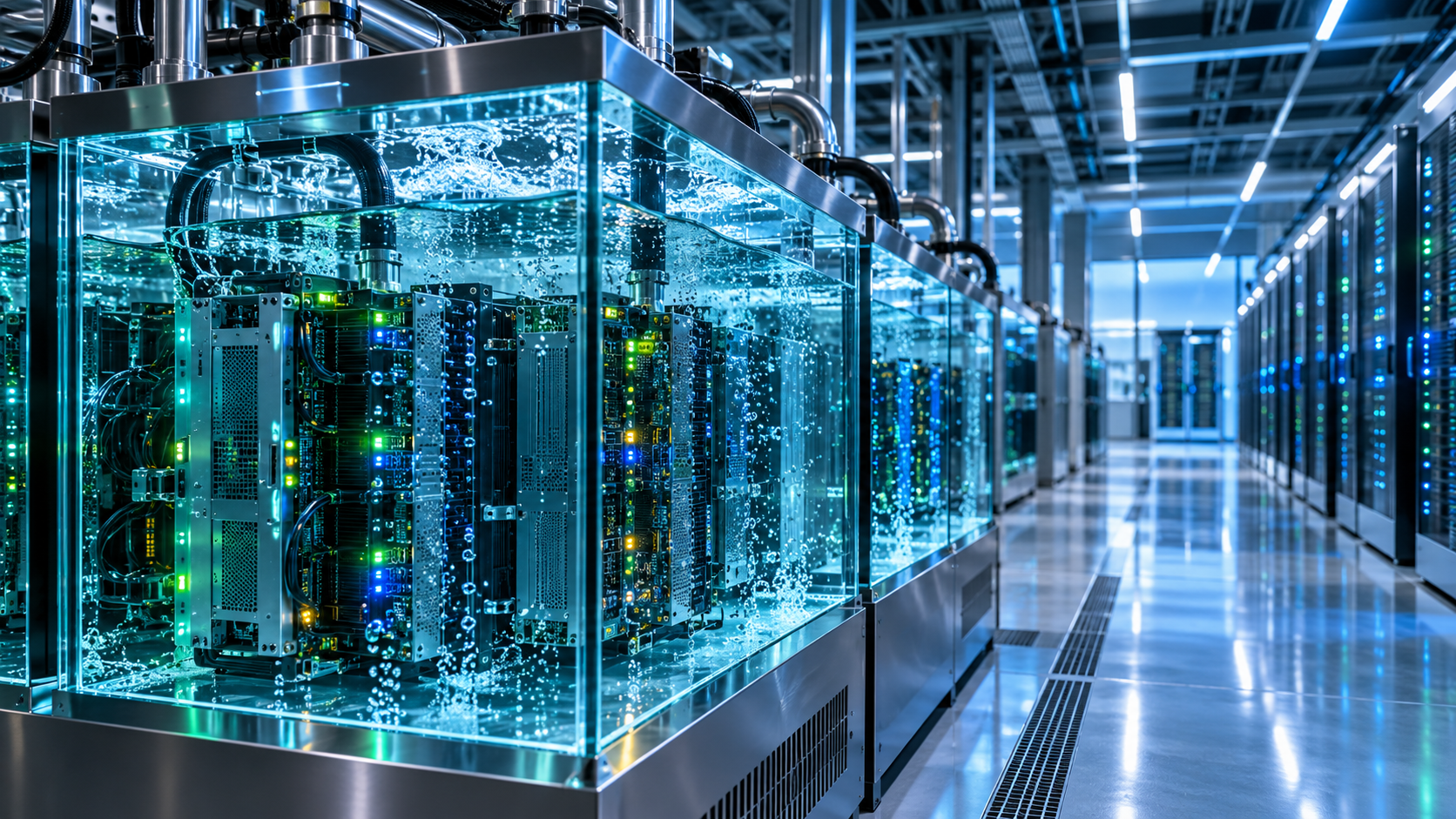
 Immersion cooling submerges servers in a non-conductive liquid so heat leaves the hardware far more efficiently than it can through moving air. For the Canadian data center industry, it is one of several liquid-cooling methods now replacing air in the densest parts of the building, mainly AI and high-performance computing. For a typical business website, though, the cooling inside the tank matters far less than where your data lives, how clean the local grid is, and how efficiently your host's facility runs overall. This guide explains how immersion cooling works, what the evidence says about its efficiency, why Canada is well placed for it, and what it changes, or doesn't, for anyone choosing Canadian web hosting in 2026.
Key takeaways
- Air cooling is reaching its physical limits at the rack densities AI hardware now needs. Liquid cooling, including immersion, is the industry's answer at the high end.
- Single-phase immersion has become the mainstream version. Two-phase immersion stalled after the main supplier of its fluids announced its exit from PFAS chemicals.
- Independent research puts immersion's energy saving at roughly half of an air-cooled baseline, not the near-total savings some older articles claimed.
- Canada's cold climate, low-carbon grids in several provinces and growing heat-reuse projects make it a strong location for efficient data centers.
- For most websites, the questions that matter are data location, grid source, facility efficiency and redundancy, not whether the servers sit in a tank.
Why Is Cooling the Defining Problem for Every Canadian Data Center?
Every watt of electricity a server uses ends up as heat, and that heat has to be removed continuously or the hardware throttles and fails. Cooling is therefore not an add-on to a data center. It is the second-largest energy load in the building after the computers themselves, and it sets a hard ceiling on how much computing a facility can hold.
The scale of that load is growing fast. The International Energy Agency (IEA) estimates that data centers used around 415 terawatt-hours of electricity in 2024, about 1.5% of global consumption, and projects that figure to more than double to roughly 945 TWh by 2030. The IEA also notes that data center electricity use has grown around 12% a year since 2017, about four times faster than electricity demand overall.
Cooling's share of that bill is substantial. Depending on climate and design, cooling can account for up to about 40% of a facility's total energy use. That share is exactly what efficiency engineers try to shrink.
What PUE tells you, and why it has stopped improving
Power Usage Effectiveness (PUE) is the industry's standard efficiency ratio: total facility power divided by the power that reaches the IT equipment. A PUE of 1.0 would mean every watt goes to computing. A PUE of 1.5 means that for every watt of computing, another half-watt goes to cooling, power conversion and lighting.
Uptime Institute's 2025 global survey found the average annual PUE reported by operators was about 1.54, with little change for the sixth year running. The survey attributes the stall partly to legacy infrastructure and regional barriers to efficient cooling. In other words, the industry has squeezed most of what it can out of conventional air cooling. Further gains need a different approach to moving heat.
Why air is running out of headroom
Air is a poor carrier of heat. To cool a hotter rack with air, you need more air, moving faster, at a lower temperature, which takes more fan and chiller energy at every step. Industry analysts describe general-purpose CPU racks as typically drawing up to about 12 kW, and air-cooled racks of earlier-generation AI accelerators at around 40 kW. Uptime's 2025 survey found most facilities still operate in the 10 to 30 kW range, with very few above 30 kW.
AI hardware has jumped well past that. NVIDIA's GB200 NVL72 rack draws approximately 120 kW, and it requires liquid cooling by design. That single number explains why the conversation about immersion cooling has moved from the fringe to the planning table.
What Is Immersion Cooling, in Plain Terms?
Immersion cooling places entire servers, including the motherboard, processors, memory and power supplies, inside a sealed tank filled with a dielectric fluid. Dielectric means the liquid does not conduct electricity, so it can touch live electronics safely. The fluid absorbs heat directly from every component and carries it to a heat exchanger, where it passes to a facility water loop and then out of the building.
Because the fluid touches every surface, immersion removes the need for server fans, raised floors, hot and cold aisles, and most of the large air-handling equipment found in a conventional data hall. Racks become horizontal tanks. Technicians lift servers out with hoists rather than sliding them from a cabinet.
There are two main forms of immersion cooling, and the difference between them now shapes the whole market.
Single-phase immersion: the version that is actually scaling
In single-phase immersion, the fluid stays liquid throughout the cycle. It is usually a synthetic hydrocarbon, a mineral oil or an engineered ester. Pumps move the warmed fluid through a heat exchanger and return it to the tank.
Single-phase systems are simpler to operate, the fluids are widely available from many suppliers, and fluid loss is minimal because nothing boils off. These are the main reasons single-phase immersion has become the most widely deployed form of the technology. Canada's most prominent example, the Nibi supercomputer at the University of Waterloo, uses nine single-phase immersion tanks.
Two-phase immersion, and why PFAS changed its trajectory
In two-phase immersion, the fluid has a low boiling point. Heat from the chips makes it boil, the vapour rises, condenses on a cooled coil at the top of the tank, and drips back down. The phase change absorbs a great deal of heat, which made two-phase immersion attractive for the hottest processors.
The problem is the chemistry. The fluids that made two-phase immersion practical were fluorinated compounds that fall within the PFAS family, the so-called "forever chemicals" now under regulatory pressure in North America and Europe. In December 2022, 3M announced it would exit PFAS manufacturing by the end of 2025, and its fluids had anchored the roadmaps of most two-phase vendors.
Cost and compatibility were already holding two-phase back. Industry reporting puts two-phase fluids at up to ten times the price of single-phase fluids, often above $50 per litre, and identifies material compatibility, how the fluid interacts with plastics, adhesives and seals, as the bigger obstacle. Some large operators shifted their immersion plans to single-phase systems or to direct-to-chip cooling instead. Two-phase research continues with newer fluid chemistries, but for anyone planning infrastructure in 2026, single-phase is the immersion technology with a dependable supply chain.
Immersion vs. Direct-to-Chip vs. Air: Which Fits Which Workload?
Immersion is not the only form of liquid cooling, and it is not even the most common one at the high end today. The main alternative is direct-to-chip cooling, sometimes called cold-plate or direct liquid cooling. It runs coolant through metal plates mounted directly on the hottest components, usually CPUs and GPUs, while the rest of the server is still cooled by air.
Direct-to-chip has become the dominant liquid-cooling method for large deployments because it fits into standard racks, needs less retraining, and keeps maintenance close to familiar procedures. NVIDIA's GB200 NVL72, the reference design for current large-scale AI, uses direct-to-chip cooling for its CPUs, GPUs and switch chips, while its networking and storage modules remain air-cooled. The most powerful AI racks shipping today, in other words, are not immersion-cooled. They are hybrids.
The following table summarizes where each method makes sense. Treat the density bands as typical working ranges rather than hard limits, because facility design changes them.
| Rack power density | Typical workload | Practical cooling approach |
| Under 10 kW | Shared web hosting, small VPS nodes, email, storage | Air cooling, ideally with outside-air or water-side economizers |
| 10 to 30 kW | Dense virtualization, databases, general enterprise compute | Well-contained air cooling, often with rear-door heat exchangers |
| 30 to 60 kW | Earlier AI accelerators, HPC clusters | Direct-to-chip liquid cooling or single-phase immersion |
| 60 kW and above | Current rack-scale AI training and inference | Direct-to-chip as standard; single-phase immersion where the facility is designed for tanks |
Where immersion has a real edge
Immersion cools every component evenly, not just the processor under a cold plate, so it avoids hot spots on memory, voltage regulators and drives. It eliminates server fans entirely, which cuts both energy and noise. It also produces warm, stable return temperatures that are well suited to heat reuse, a point that matters a great deal in a cold country.
Where direct-to-chip wins today
Direct-to-chip can be added to an existing air-cooled building, works with standard server designs and leaves technicians with procedures they already know. Immersion usually requires purpose-built tanks, floor loading for heavy fluid-filled vessels, lifting equipment, and immersion-ready hardware. For a facility that already exists, that difference often decides the question.
What Does an Immersion Deployment Actually Involve?
Diagrams of servers sitting in a glowing tank make immersion look simple. The operational reality is more involved, and it explains why adoption has been slower than the technology's efficiency alone would suggest.
Structural loading. A tank full of fluid and servers is far heavier per square metre than an air-cooled rack. Floors in older buildings, and especially raised floors, may not carry that load without reinforcement.
Hardware readiness. Standard servers are designed for air. Fans must be removed or disabled, some thermal pastes and labels break down in certain fluids, and spinning hard drives generally cannot be immersed. Operators need hardware that the manufacturer supports for immersion, or they risk running equipment outside its warranty terms.
Fluid management. Fluid must be filtered, tested and topped up over the life of the system. Spills need procedures and containment. Fire-safety review and insurance terms may differ from those for a conventional data hall, because insurers and inspectors have less history with tank-based designs.
Servicing and staff skills. Replacing a memory module means lifting a server out of the tank, letting it drain, and cleaning it before work begins. That is slower than sliding a server out of a rack, and it requires training most data center technicians have not yet had.
Heat rejection still needs a plan. Immersion removes heat from the servers, but the heat must still leave the building through dry coolers, cooling towers or a heat-reuse connection. Immersion does not use water as its primary cooling medium, which helps where water is scarce, yet a site may still use water indirectly, depending on how it rejects heat.
None of these points make immersion a bad choice. They make it a design decision best taken at the start of a project rather than bolted onto an existing building, which matches what both independent researchers and Canadian operators have found.
What the Efficiency Numbers Actually Say
This is where most articles on immersion cooling go wrong, so it is worth being precise.
Vendors of competing cooling technologies publish directly contradictory claims. One immersion vendor argues that immersion achieves a lower PUE than direct-to-chip because direct-to-chip still needs some air cooling. A direct-to-chip vendor argues the reverse, claiming its approach can use up to half as much cooling energy as immersion. Both cannot be generally true, and both come from companies selling the product they favour. A reader should treat vendor efficiency figures as marketing until an independent party or a named operator confirms them.
Independent evidence is more modest and more useful. A peer-reviewed study published in Energy Informatics in 2023 compared air and immersion cooling quantitatively. It found that immersion reduced energy consumption by about 50% and occupied space by about two-thirds. The same study flagged harder maintenance and an increased rate of IT failures as the main downsides. It also concluded that retrofitting an air-cooled data center for immersion is costly and generally not recommended.
Operator data from Canada points in the same direction. The University of Waterloo's Nibi deployment reports up to a 50% reduction in cooling energy compared with air cooling.
Correcting an outdated claim. Earlier coverage of immersion cooling, including the first version of this article, repeated a claim that immersion could save up to 99% of electricity compared with conventional cooling. No credible independent source supports that figure. A realistic expectation is that immersion can cut cooling energy roughly in half against a comparable air-cooled design, with the largest gains in dense, purpose-built facilities.
Why a lower PUE is not the whole story
Immersion can make PUE look better partly because it removes server fans, which are counted as IT load in the ratio. Some of the improvement is real energy saved; some is energy moved from one side of the equation to the other. A data center's actual environmental impact also depends on where its electricity comes from and whether its waste heat is used. A facility with a modest PUE running on hydroelectric power can have a much smaller carbon footprint than an ultra-efficient one running on a fossil-heavy grid.
Why Canada Is a Natural Home for Next-Generation Cooling
Canada's advantages for efficient data centers come from three directions at once: climate, electricity and the growing value of waste heat. Immersion cooling interacts with all three.
A cold climate that cools for free much of the year
Free cooling means using cold outside air or water to reject heat instead of running mechanical chillers. Canada's climate allows it for long stretches of the year, and Canadian operators have documented it for more than a decade.
MTS Data Centres in Winnipeg has described cooling its data hall with outside air for most of the year, in a city that can stay below 0°C for around six months. A Toronto operator reported free cooling for more than 75% of the year using a pumped-refrigerant economizer. TELUS designed its Kamloops facility to use outside air for cooling 99% of the year when it opened in 2014.
Free cooling and immersion are complementary. Immersion systems run warm. Their fluid can operate at temperatures high enough that the heat can be rejected to outdoor air without chillers for even more of the year. A cold climate widens that window further.
Electricity grids that vary sharply by province
Canada's grid is one of the cleanest in the world overall, with roughly 80% of electricity coming from non-emitting sources, but the national figure hides big provincial differences. According to the Canada Energy Regulator, British Columbia, Manitoba, Quebec, and Newfoundland and Labrador typically generate more than 85% of their electricity from hydro. Ontario relies on a mix that includes nuclear and hydro. Alberta, Saskatchewan and Nova Scotia generate most of their electricity from fossil fuels.
| Province | Main electricity sources | What it means for a data center's footprint |
| British Columbia | Predominantly hydro | Very low carbon intensity; cooling efficiency mainly affects cost |
| Quebec | Predominantly hydro | Very low carbon intensity; strong appeal for large AI campuses |
| Manitoba | Predominantly hydro | Very low carbon intensity plus a long free-cooling season |
| Ontario | Nuclear and hydro, with gas and renewables | Low carbon intensity; gas generation can rise at peak demand |
| Alberta | Mostly natural gas | Higher carbon intensity; cooling efficiency matters more for emissions |
For a data center in Vancouver or Montreal, a more efficient cooling system mainly lowers the power bill. For one in Calgary, the same improvement also cuts emissions meaningfully. That is why a facility's province can matter as much as its cooling design.
Waste heat as a resource, not a problem
In a country that spends heavily on heating, a data center's waste heat has real value. Liquid cooling makes it easier to capture because heat leaves in a concentrated stream of warm fluid instead of a diffuse flow of warm air.
Three Canadian projects show the range. Nibi's immersion system sends its heat to warm the University of Waterloo's Mike and Ophelia Lazaridis Quantum-Nano Centre next door. In downtown Toronto, Telehouse Canada's direct liquid cooling system passes heat into Enwave's district energy network, where it helps warm the city's municipal drinking water. In Lévis, Quebec, QScale has planned greenhouses beside its data center campus to use recovered heat for food production.
Canadian Liquid and Immersion Cooling in Practice
Canada's adoption so far has come mostly from research computing, interconnection hubs and crypto mining rather than from hosting providers. Each example shows a different reason to move to liquid.
Nibi: Canada's first large-scale immersion-cooled supercomputer
The University of Waterloo's Nibi system, operated with the SHARCNET research computing consortium, is described as Canada's first large-scale immersion-cooled supercomputer. It combines nine single-phase immersion tanks for its CPU nodes with direct-to-chip cooling for its GPU subsystems, a practical illustration that the two methods are often used together. The roughly $50-million system replaced Waterloo's previous flagship, Graham, and serves researchers across a consortium of 19 academic institutions.
SHARCNET's director of technology, John Morton, put the lesson simply: "Sites doing large deployments should seriously consider immersion cooling." The emphasis on large deployments is the important part.
Telehouse Canada: liquid cooling inside an interconnection hub
In 2026, Telehouse Canada completed a direct liquid-to-chip upgrade in its downtown Toronto facilities to support high-density AI inference. The company says the system removes up to 80% of heat directly from high-power server components, reducing reliance on computer room air conditioners and server fans. It has described this as the first liquid-cooled interconnection hub in Canada.
Crypto mining: the early adopter
Cryptocurrency miners adopted immersion early because their hardware runs flat out and is relatively uniform. DMG Blockchain's Christina Lake, B.C. facility, which the company describes as one of Canada's largest single crypto mining sites, adopted immersion cooling with a company-reported 30% improvement in miner hashrate. That is a vendor-reported figure, but it reflects why immersion first took hold where heat density was extreme and hardware was easy to standardize.
Does Immersion Cooling Matter for Your Website?
For most businesses buying Canadian web hosting, the honest answer is: not directly. A shared hosting server or a typical virtual private server (VPS) node produces a small fraction of the heat of an AI rack. Hosting hardware of that kind sits comfortably in the under-10 kW band, where well-managed air cooling with free-cooling economizers remains efficient and proven. No hosting customer needs their WordPress site sitting in a tank of fluid.
What does matter is how the data center underneath your hosting is located, powered and run. Those factors shape your site's speed, reliability, compliance position and environmental footprint far more than the cooling medium does.
Speed and search visibility
Physical distance still adds latency. A Canadian business serving Canadian customers usually gets faster server response from a nearby facility in Canada than from one across the continent. Server response time feeds into Time to First Byte and, through it, into the page-experience signals that influence search performance. Hosting is not a ranking shortcut, but a slow, distant server makes every other optimization harder.
Reliability
Cooling failures are a classic cause of data center outages, because overheated equipment shuts itself down. What protects a website is not the cooling technology itself but redundancy: spare cooling capacity, backup power, and, at the hosting level, copies of your data in a second location.
A practical example
Consider a Vancouver accounting firm with a client portal and a Toronto e-commerce retailer selling across Ontario. Neither runs AI training. Both need fast pages for Canadian visitors, personal information stored with a clear accountability trail, and recovery if one site has an incident. A host that keeps data in Canadian facilities, near those customers, with off-site replication between regions, serves them well. Whether a hyperscale AI campus in Quebec uses immersion tanks has no bearing on either firm's results.
When the answer changes
The picture shifts if a business starts running its own AI workloads. A software company that hosts a customer-facing chatbot on its own GPUs, or a research team training models on proprietary data, is suddenly drawing far more power per server than a website ever would. At that point the cooling capability of the facility becomes a real selection criterion: can it supply the power per rack the hardware needs, and does it offer liquid-cooled space or a partner that does?
Even then, most growing businesses split the work. The website, email and databases stay on conventional hosting near their customers, while the GPU-heavy layer runs in a facility built for it. Keeping those two layers separate is usually cheaper and simpler than forcing everything into a high-density environment, and it lets each part sit where it performs best.
That is the position 4GoodHosting takes with its own infrastructure. Its hosting runs from data centers in Vancouver and Toronto, two cities whose provincial grids rely heavily on hydro and, in Ontario's case, nuclear power, and it replicates data between the two locations so a regional incident does not take a site's data with it.
Data Residency, PIPEDA and Where Your Data Physically Lives
Cooling is about the physics of a building. Data residency is about the law that applies to what is stored inside it. For Canadian organizations, the second question usually matters more.
Canada's federal private-sector privacy law, the Personal Information Protection and Electronic Documents Act (PIPEDA), does not prohibit organizations from transferring personal information outside Canada for processing. This is a point many hosting articles get wrong. What PIPEDA does require is accountability. The Office of the Privacy Commissioner of Canada (OPC) explains that an organization remains responsible for personal information it transfers to a service provider, must use contractual or other means to ensure comparable protection, and should tell individuals that their information may be processed in another jurisdiction and may be accessible to that jurisdiction's courts, law enforcement and national security authorities.
Provincial rules add layers. British Columbia and Alberta have their own private-sector privacy statutes. Quebec's private-sector law, as amended by Law 25, requires a privacy impact assessment before personal information is communicated outside the province. Public bodies, health custodians and many government contracts can carry stricter residency expectations still.
The practical consequence is straightforward. Hosting personal information in a Canadian data center does not by itself make an organization compliant, but it removes a layer of cross-border risk and makes the accountability trail far simpler to document. For many Canadian businesses, that simplicity is the main reason to choose Canadian web hosting in the first place.
Seven Questions to Ask Your Hosting Provider About Its Data Center
If you want to evaluate a host's infrastructure without becoming a mechanical engineer, these seven questions get to what matters. A good provider can answer each one plainly.
- Where, exactly, is my data stored and backed up? Ask for the city of the primary data center and the location of backups. "Canadian company" does not always mean Canadian servers.
- Is the facility powered by a low-carbon grid? The province largely answers this, as the grid table above shows. Some operators also buy renewable energy certificates; ask what share of consumption they cover.
- What is the facility's PUE, and is it measured or designed? A designed PUE is a target. A measured annual PUE is evidence. Compare it against the global average of about 1.54.
- How is the facility cooled, and how much of the year does it use free cooling? For ordinary hosting hardware, a strong free-cooling design matters more than whether any liquid cooling is installed.
- What redundancy exists for cooling and power? Look for spare cooling units, backup generators and uninterruptible power supplies sized to carry the load through an outage.
- Is my data replicated to a second, geographically separate location? A second region protects against fires, floods, earthquakes and extended power events that redundancy within one building cannot.
- Can the provider support heavier workloads if I grow? If you plan to run machine-learning inference or other GPU work later, ask whether the provider or its facility partners offer high-density or liquid-cooled capacity, or whether you would need a specialist for that layer.
These questions shift the conversation from marketing language such as "green" and "enterprise-grade" to specifics you can check.
What Comes Next: The 2026–2030 Outlook for Data Centers in Canada
The direction of travel is clear, even if the exact pace is not.
Liquid cooling will become standard for high-density zones, not whole buildings. Most new data centers will be hybrids: air-cooled halls for general hosting, storage and networking, alongside liquid-cooled zones for AI and HPC. Direct-to-chip will remain the default for those zones in the near term, with single-phase immersion growing where operators build specifically for it.
Public investment is pushing AI capacity onshore. The federal government's Canadian Sovereign AI Compute Strategy committed $2 billion, including up to $700 million through the AI Compute Challenge for private-sector AI data centers and related infrastructure. Projects funded under it will need cooling designed for AI-class density from day one.
Electricity, not cooling, will become the binding constraint. The IEA's projection of data center demand more than doubling by 2030 means grid access and power pricing will shape where Canadian capacity gets built. Efficient cooling stretches each megawatt further, which is exactly why it matters to operators.
Water and heat will face more scrutiny. Large proposals in Canada increasingly use closed-loop cooling that needs little or no water for normal operation. Meta has said its planned data center in Sturgeon County, Alberta will need no water for regular cooling. Heat-reuse projects like those in Waterloo and Toronto are likely to become an expectation for large new builds in cold Canadian cities, not a novelty.
Fluid chemistry will keep evolving. With PFAS-based two-phase fluids winding down, expect continued development of hydrocarbon and ester fluids for single-phase immersion, and more work on making the immersion supply chain as standardized as the air-cooling world it is replacing.
Frequently Asked Questions
Is immersion cooling safe for servers?
Yes, when the fluid is a proper dielectric and the hardware is rated for immersion. The fluid does not conduct electricity, so it can contact live components. The main risks are practical ones: some plastics, adhesives and labels degrade in certain fluids, servicing is messier than with air-cooled hardware, and independent research has noted higher IT failure rates in some immersion deployments. Purpose-built, immersion-ready hardware reduces these issues.
How much energy does immersion cooling save?
Independent research and Canadian operator data both point to roughly half the cooling energy of a comparable air-cooled design. Vendor claims above that figure should be treated cautiously unless an independent party or a named operator confirms them. The overall saving for a whole facility depends on how much of its energy went to cooling in the first place.
Is immersion cooling better than direct-to-chip liquid cooling?
Neither is better in every case. Immersion cools all components evenly and suits purpose-built facilities and heat reuse. Direct-to-chip fits into existing buildings and standard racks more easily, which is why it is the dominant liquid-cooling method for large AI deployments today. Many sites, including Canada's Nibi supercomputer, use both.
Do Canadian web hosting companies use immersion cooling?
Very few, and for good reason. Typical web hosting hardware runs at low rack densities where efficient air cooling with free-cooling economizers works well. Immersion is most valuable for AI, HPC and crypto mining, where heat density is extreme.
Why are so many data centers being built in Canada?
Canada combines a cold climate that enables long free-cooling seasons, several provinces with predominantly hydroelectric grids, political stability, and federal investment in AI compute. Those factors lower operating costs and emissions for energy-intensive facilities.
What is a good PUE for a data center?
Lower is better, and context matters. Uptime Institute's 2025 survey put the average reported PUE at about 1.54. Large, modern facilities designed for efficiency typically report figures well below that, and immersion-cooled sites can go lower still. When comparing providers, ask whether a figure is a measured annual average or a design target, because only the first is evidence.
Can an existing data center be converted to immersion cooling?
It can, but it is rarely the best route. Floor loading, power distribution, hardware compatibility and heat rejection all need rework, and peer-reviewed research has concluded that retrofitting an air-cooled facility for immersion is costly and generally not recommended. Operators with existing buildings more often add direct-to-chip cooling or dedicate a new zone to immersion.
Does a Canadian data center make my site PIPEDA compliant?
No single hosting choice makes an organization compliant. PIPEDA does not require personal information to stay in Canada, but organizations remain accountable for it wherever it is processed. Keeping data in Canada simplifies that accountability, and some provincial, public-sector and contractual requirements do expect Canadian storage. For a regulated situation, confirm your obligations with a privacy professional.
The Bottom Line
Immersion cooling is a genuine part of the future of the Canadian data center. It already runs Canada's first large-scale immersion-cooled supercomputer and is spreading wherever heat density outgrows air. It will not replace every cooling system, though. The near future belongs to hybrid facilities, where air handles ordinary workloads efficiently and liquid, whether immersion or direct-to-chip, takes over at the high end.
For a business choosing a host, the lesson is to look past the cooling hype to the fundamentals: Canadian data location, a clean provincial grid, measured efficiency, real redundancy and a second site for your data.
4GoodHosting has built its Canadian web hosting on those fundamentals, with data centers in Vancouver and Toronto and replication between them. If you want your website hosted close to your Canadian customers and under a clear Canadian accountability trail, explore the plans at 4GoodHosting.